
France's highest court is being advised to throw out Marine Le Pen's last appeal. A preliminary report by judges at the Court of Cassation recommends rejecting her appeals against her embezzlement conviction, before the court sits on December 16 — and if the court follows it, the punishment set in July takes effect: one year at home wearing an electronic ankle tag and a €100,000 fine, for the woman leading every poll for the presidency.
Le Pen is the front-runner for the April 2027 election — a poll this month put her at 33 percent, seventeen points clear of her nearest rival. A final conviction would not bar her, but it would put the favourite for the presidency under house detention for a year, with a judge deciding the hours she may leave home to campaign.
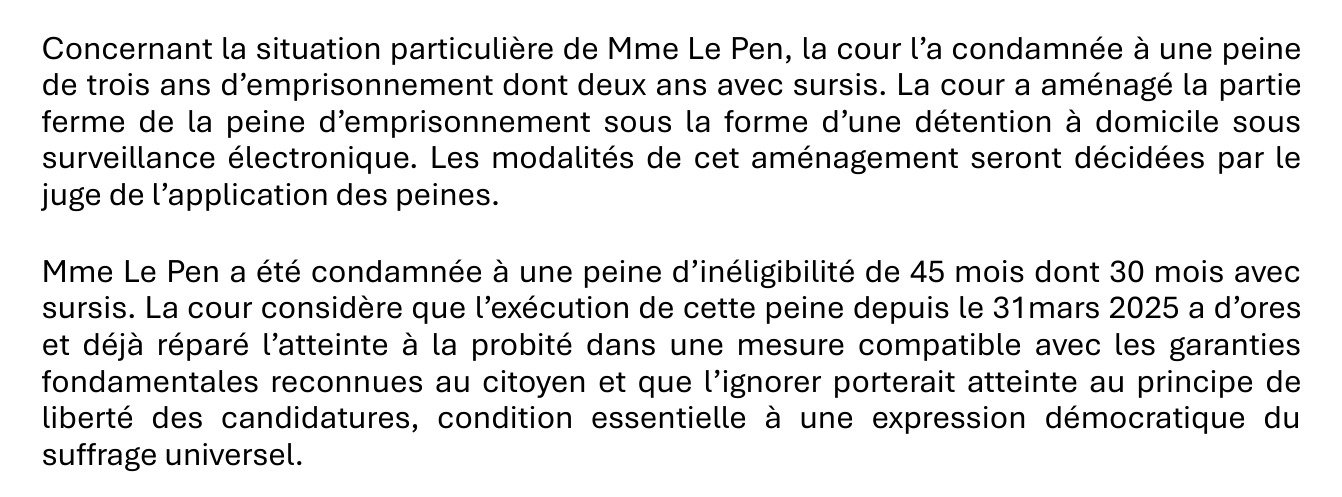
The Paris Court of Appeal upheld her conviction on July 7 for organising the system that paid party staff with European Parliament money — €2.8 million of it, the court found. It cut her sentence to three years in prison, two of them suspended, and ordered the remaining year served as "home detention under electronic surveillance," with the terms set by a sentence-enforcement judge. Her ban from office was cut to 45 months, 30 of them suspended, and the firm fifteen months had already run, so she stays eligible.
Le Pen denies wrongdoing. First convicted in March 2025 — four years in prison and a five-year ban that took effect at once — she called the prosecution's demands "a very violent attack on democracy" and said for months that she would not campaign wearing a tag. The night the appeal court ruled, she announced she was running anyway, and took the case to the Court of Cassation to campaign without the bracelet.
Her appeal froze the punishment while the top court decides points of law only. On December 16 it takes up the constitutional questions her lawyers have raised, with a decision expected the same day, and it has promised a final ruling by early April 2027 at the latest, weeks before the first round on April 18.
Thirteen appeals were lodged against the July ruling in all. If the court rejects hers, the tag year begins in the campaign's final stretch; if it quashes the ruling, the case goes back for a retrial and she campaigns free.