
IBM is ending the sponsorship that lets its foreign employees live and work in America. The company has confirmed it will stop sponsoring H-1B visas — the permit that lets American employers hire skilled workers from abroad — and stop green-card sponsorship, the backing a worker needs to settle permanently, for most jobs in IBM Consulting, its biggest division, with more than 150,000 employees. Workers caught by it were called into one-on-one meetings and given three weeks to choose: take an IBM job abroad, or leave — reportedly with three months' severance and December 31 as the last day.
Why it matters: sponsorship is not paperwork — it is the thread an American life hangs on. Many of these workers have waited years in the green-card queue, and an H-1B worker who loses his job has up to 60 days to find a new sponsor, change status or leave the country. And one of America's oldest technology names is now narrowing the door for skilled foreign workers altogether.
IBM's stated reason is skills. “IBM Consulting participates in U.S. high-skilled visa programs to address skill shortages,” it says — but “as skill availability and client need have evolved, we have opted to discontinue visa and green card sponsorship for the majority of such roles in IBM Consulting.” But the cut lands under President Donald Trump's immigration pressure: a $100,000 fee placed on new H-1B petitions in September 2025, and other technology giants suspended from the green-card labour programme in October. IBM has never said that pressure caused this — it says skills. The question the timing leaves open is how much is skills, and how much is a climate that has made sponsoring a foreign worker costlier and riskier by the month.
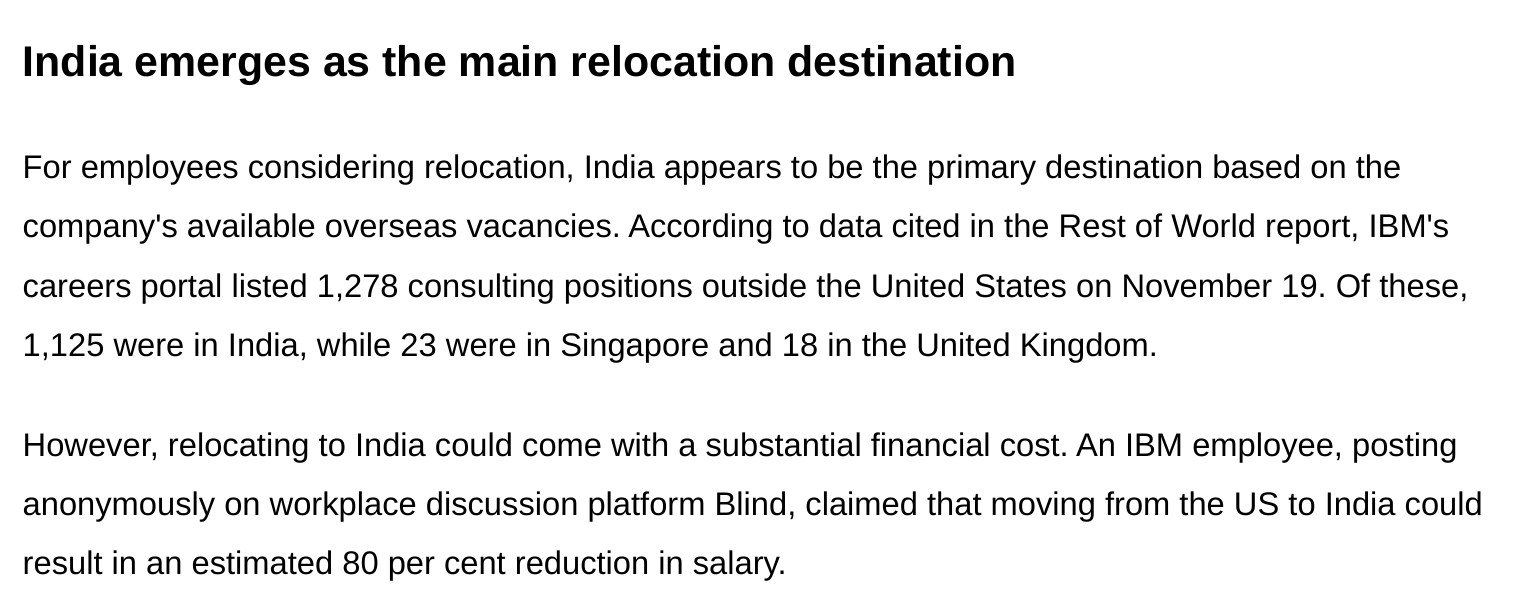
IBM's case: the cut covers Consulting only, not the whole company, and its sponsorship was already shrinking — about 1,600 H-1B approvals last year, down from nearly 3,000 two years before. The workers' case: the alternative jobs sit overwhelmingly in India, and one employee, posting anonymously on Blind, estimated a move there could cut pay by some 80 percent — an anonymous estimate IBM has not confirmed. IBM has not said how many workers are affected.
The next three weeks will tell: how many take the transfer, how many take the severance — and whether other big employers, feeling the same pressure, follow IBM.