
Toronto is looking at the phone bill of nearly every person in the city to fill its budget hole. City staff are proposing a $2-a-month charge on every cellphone line — a “Next Generation 911” fee the phone companies would collect and hand to the city — as Mayor Olivia Chow’s government faces a $1.1 billion shortfall in the 2027 budget.
Why it matters: 92 percent of Torontonians have a cellphone, and landlines are exempt — so the fee lands on almost everyone at $24 a year per line and $96 a family of four. It comes from a mayor elected on making life more affordable, on top of a 9.5 percent property tax rise in 2024 alone.
The city’s own public notice says the fee would “support investments in emergency services,” with a target start of October 1, 2027, and it would raise about $65.1 million a year. It does not come alone: the hotel tax rises from 6 percent to 8.5 percent on March 1, 2027, worth $57.4 million, and a commercial parking levy — $12 per square metre downtown and on the waterfront, $6 elsewhere — arrives in January 2029, worth up to $150 million a year. Together the three bring in about $272.6 million a year by 2029, which the city itself equates to a 1.27 percent property tax rise.
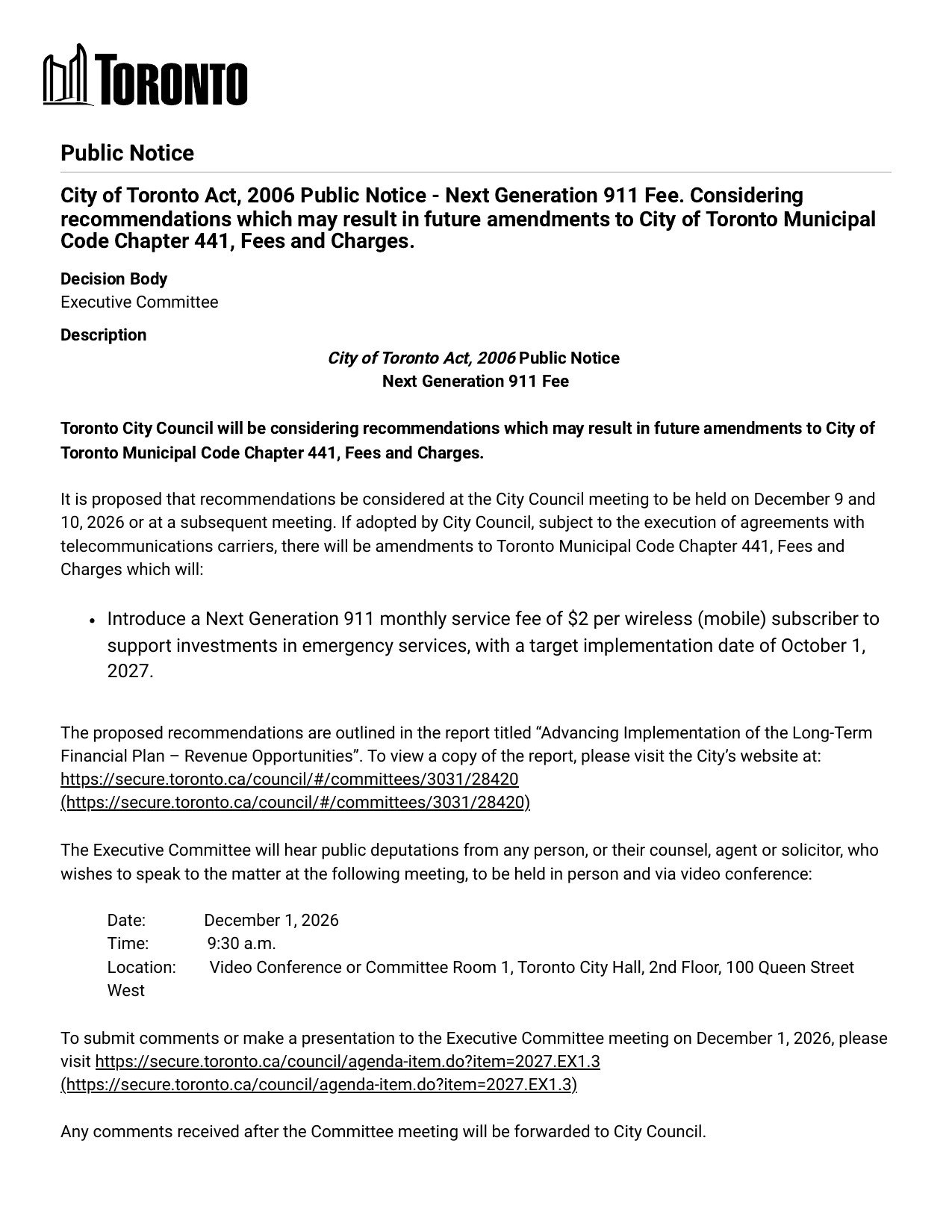
The city says Toronto faces significant financial pressures, with an over-reliance on the property tax, and the mayor’s office calls the approach “a made-in-Toronto solution.”
The city’s finance chief said Toronto’s “next generation” 911 system will cost about $400 million and will be fully funded by 2037. Council would still have to vote to approve the fee — in December — and the money would go into the 911 system — not the city’s general revenue, city staff said.
The proposed fee arrives as other Canadian cities are weighing similar levies. Montreal adopted a $52 annual municipal charge for 911 in 2025, with $42 for residents and $52 for businesses. Toronto’s $24 a year per line would mean a family of four would pay $96 a year, which is higher than Montreal’s flat charge. City council will vote on the fee in December.
Here’s the rub: the fee would hit newcomers and lower-income households hardest, the very people who rely most on mobile phones. Renters could be charged even if their phone is on a family plan — and the fee would be collected by phone companies, not the city, with no clear way to appeal.