Zelensky Says Calling Putin a Friend Is Like Calling Hitler a Friend in World War II: 'He Can't Be a Friend'
ProfiloPolitics Editorial · November 22, 2026
Volodymyr Zelensky has told the BBC it is 'strange' for Donald Trump to call Vladimir Putin 'my friend,' saying the Russian leader is 'an aggressor, and a killer' who 'can't be a friend' — like calling Hitler a friend in World War II. Zelensky also accused Washington of focusing on the Middle East while delays to anti-ballistic missile deliveries cost Ukrainian lives.
Friday, November 27, 2026
Volodymyr Zelensky has told the BBC it is "strange" for Donald Trump to call Vladimir Putin "my friend," saying the Russian leader is "an aggressor, and a killer" who "can't be a friend." "It's the same that somebody say about Hitler during the Second World War, that he's a good friend," Zelensky said in English, in an interview with the BBC's Sarah Rainsford at his office in central Kyiv. "No. He's not a friend."
Why it matters: the words are aimed at the language Trump used after their 40-minute meeting in Shenzhen last week, when he posted a photograph of himself embracing Putin and called him "my friend." For Kyiv, the friendship language signals how hard Washington will push Moscow: Zelensky's complaint is that the United States is not pushing Russia hard enough, and that delays in delivering vital anti-ballistic missiles are costing Ukrainian lives.
Zelensky also accused the United States of focusing too much on the Middle East at Ukraine's expense. "It's a pity they made a focus on Middle East and they help them more… It's a pity. We have huge questions with this," he said. He added that Ukraine's forces can now destroy about 70 percent of Russia's fastest drones, a figure he said was improving.
American officials have defended Trump's phrasing as diplomatic engagement aimed at a quick peace deal, and Trump's envoys Steve Witkoff and Jared Kushner have been trying to negotiate an end to the war. But Zelensky said the two envoys often seem more in tune with Moscow's position than Kyiv's, and that it remained uncertain whether European representatives would join the next round of talks, despite an earlier announcement by the American envoys. What happens next is the next round itself, expected in December — and whether Europe has a seat at the table.
Thursday, November 26, 2026 (yesterday)
During the same Thanksgiving calls to American service members from Mar-a-Lago, Trump told a service member who asked how he spent the holiday that he was working on "a little project" called Iran, and another "little project" aimed at bringing peace between Russia and Ukraine. "The two leaders hate each other," he said of Putin and Zelensky, but he said he remained focused on finding a path toward peace.
Why it matters: on Iran, Trump used the call to warn Tehran again, calling its leaders "crazy" and saying the United States would not let Iran develop a nuclear weapon, because Iran can already reach parts of Europe and must be stopped from developing a longer-range threat. The war with Iran, which began on February 28, is paused rather than over: the United States is still blockading Iran's ports and traffic through the Strait of Hormuz remains disrupted, so the choice Trump faces — a strike, a deal, or more of the blockade — reaches directly into fuel prices and the safety of American personnel in the region.
Trump also praised First Lady Melania Trump for the ceasefire she helped secure around Oleshky in Ukraine's Kherson region last month, which let more than 800 people evacuate a dangerous war zone where they were likely to have been killed. "A pretty amazing job," he said, joking that she should negotiate for the country. The six-day ceasefire around Oleshky ran from October 27 to November 1.
The Trumps spoke with troops stationed around the world, including service members aboard the USS Portland. What happens next sits in two places: Trump's decision on Iran, and the December round of Russia-Ukraine talks.
— What follows is the story as first written · the update is above —
Thursday, November 26, 2026 (yesterday)
President Donald Trump said on Thanksgiving Day that former President Barack Obama's decision to expel Vladimir Putin from the G8 helped create the conditions for the Ukraine war, arguing that if Russia had stayed in the group, "you might not have this war right now."
Trump made the remarks during his Thanksgiving calls to American service members from Mar-a-Lago in Florida, after a reporter asked whether Putin would attend the G20 summit at his Doral resort next month. "When he was a member of the G8, if he stayed a member — President Obama wanted him out, and if he stayed a member, you might not have this war right now," Trump said. "He was very insulted when that happened. And now it's the G7, and to be honest with you, all we do is talk about Russia. I said, 'Why isn't he here?'"
Why it matters: the war is in its fifth year, and it has cost American taxpayers heavily in aid while pushing energy and food prices up around the world. Trump's argument is that keeping Putin at the table would have preserved a channel for dialogue; his critics answer that Russia was suspended from the group in 2014 after it annexed Crimea, as a consequence for violating Ukraine's sovereignty.
Trump also said Putin wants an end to the fighting. "The bottom line is he would like to make a deal," he said, adding that his priority was stopping the loss of life and that keeping a cordial relationship with the Russian leader mattered to the negotiation. Open hostility toward Putin, he said, could complicate efforts to reach a settlement.
On the G20, Trump said Putin would be welcome at the December 14–15 summit at Doral. "I don't know, but if he wanted to come, he certainly can. Some people wouldn't like that," he said. "If it were up to me, I'd like to have him." The Kremlin said on Thursday that no decision had been taken on Putin's participation.
— What follows is the story as first written · the update is above —
Thursday, November 26, 2026
President Donald Trump said on Thursday that he told Vladimir Putin during their conversations in China that he would like to see the Russian leader "pull back all military aggression against territories throughout Europe", in the hope that the deal between Russia and Ukraine can be made quickly. "I really believe this is a strong possibility – Thousands of people are being killed each and every month, A COMPLETE BLOODBATH," he wrote on Truth Social.
Why it matters: the language reaches further than his usual call to end the war in Ukraine. "Territories throughout Europe" goes beyond the battlefield, days after two Russian cruise missiles and a jet-powered drone crashed in Poland, and Estonia linked an arson attack to Russian military intelligence. For households on both sides of the Atlantic, a deal is the only thing that stops the war setting energy and food prices — and every month without one adds to a death toll Trump puts in the thousands.
The post came a day after his meeting with NATO Secretary-General Mark Rutte at Mar-a-Lago on Thanksgiving Eve, which Trump called an "outstanding meeting". In a joint statement afterwards, Trump and Rutte said Russia must avoid any actions that "intentionally or unintentionally expand the war" and stressed a peaceful resolution as rapidly as possible. Trump said he updated Rutte on his talks with Putin, and the two also discussed expanding defense spending and investment in the industrial base across NATO.
Trump did not say what conduct he was asking Putin to halt, or what a deal would require of either side. The last direct talks – two days in Abu Dhabi on November 10 and 11 – ended with no agreement, and the Kremlin has tied any settlement to a new security architecture for the whole continent. Ukraine's position and security guarantees remain central to any lasting settlement, and Russia's willingness to withdraw its forces and accept a deal remains the major obstacle. Where it stands: the Thanksgiving-week appeal is now with Moscow, and whether it moves anything will be told by the Kremlin's answer.
Sunday, November 22, 2026
Volodymyr Zelenskyy has called Vladimir Putin an "enemy" and a "killer" after President Donald Trump called the Russian leader "my friend" in Shenzhen, warning that friendly language means Putin "doesn't feel enough pressure" to stop the war. Zelenskyy said the comment showed Trump did not understand how the Kremlin sees the conflict – and the contrast sharpened after Trump's own intelligence chief said Putin is "not America's friend".
Trump defended the language at a White House briefing on Friday, after CNN's Kaitlan Collins asked whether the president is a "puppet" of Putin. "No, I'm a friend of all countries," he said. "I get along with countries." He said he did not have a "friendship" with Putin, and dismissed the idea that the Russian president "controls" him.
Trump's own intelligence chief then drew the line. Director of National Intelligence Jay Clayton, appearing on the Sunday shows, said Putin "is not America's friend, but I also do not believe he is our enemy." His predecessor Tulsi Gabbard, who led the agency before Clayton, took the same line in a Truth Social post. "Make no mistake, Putin is NOT America's friend," she wrote, "but he is also NOT an enemy." It is the clearest distance the administration has put between its leader's language and its intelligence.
The ground has moved against the warmth since Thursday. Putin ruled out returning to limited ceasefires, called his military "invincible" and refused to stop striking Ukraine's energy grid – even as he said he would not allow a military defeat. Ukraine's position has not changed: its sovereignty is non-negotiable. The Shenzhen embrace, now, reads as a moment of flattery, not a settlement.
— What follows is the story as first written · the update is above —
President Donald Trump sat down with Vladimir Putin in Shenzhen this week for 40 minutes, one-on-one, on the sidelines of a first-ever three-way summit with China's Xi Jinping. It was their most consequential meeting yet on the war in Ukraine — and the White House says a major announcement may be coming soon.
Why it matters: the war in Ukraine is now in its fifth year, and it has cost American taxpayers hundreds of billions. A president who comes out of a private meeting with the man behind that war and calls him "my friend" is a shift in how America talks about its adversary — and Kyiv is watching every word.
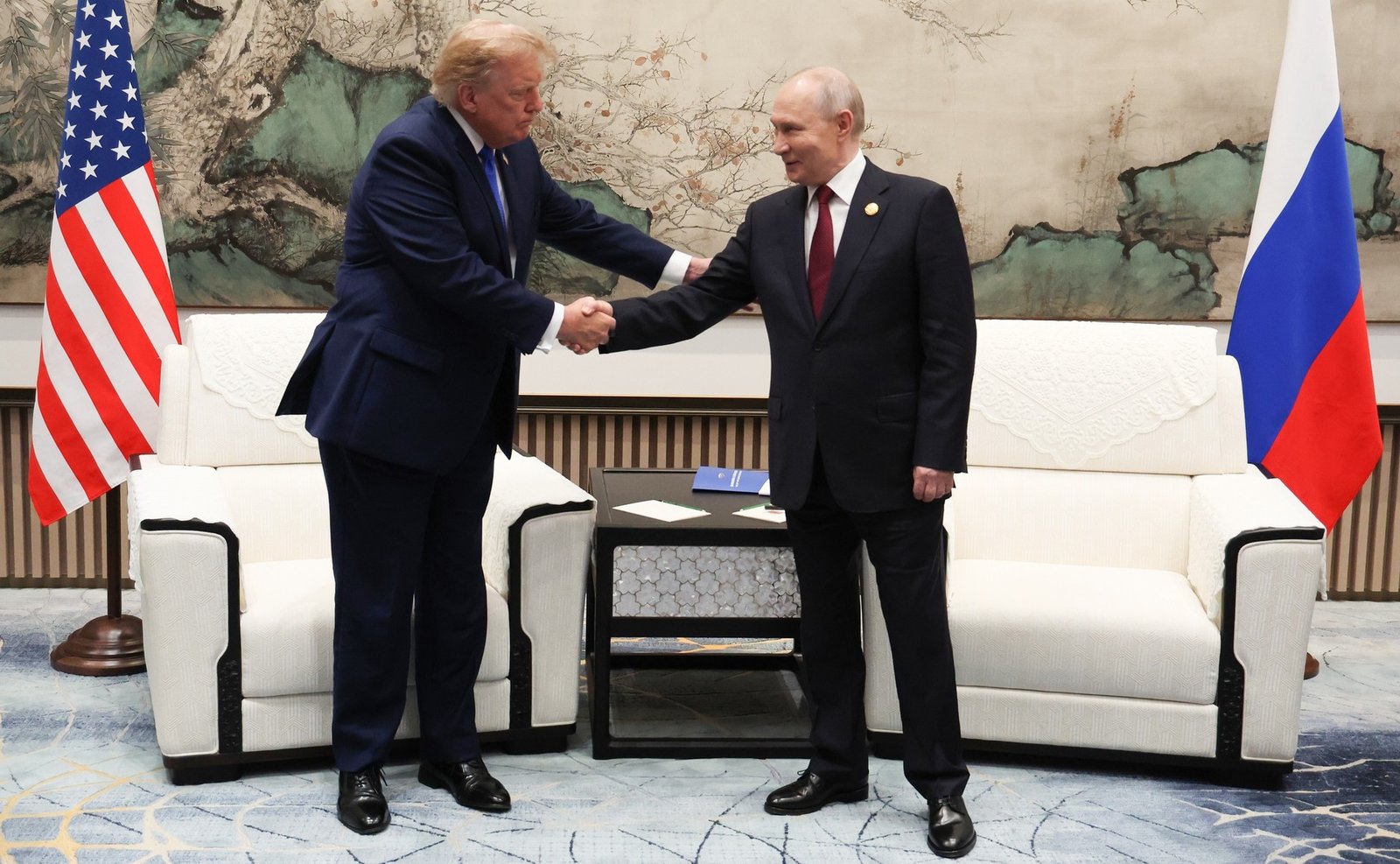
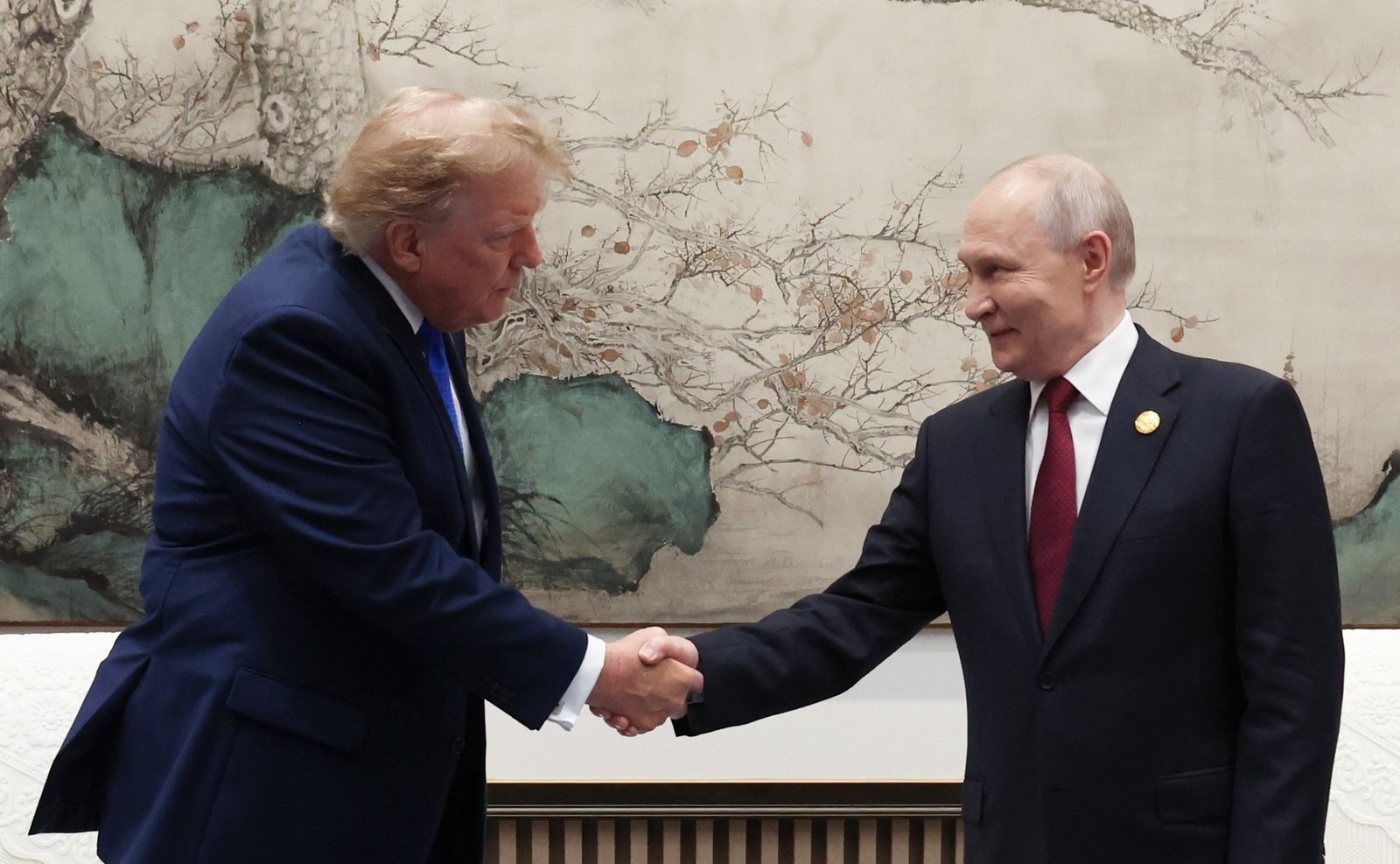
Before the doors closed, the two men shook hands in front of the cameras and Trump set out his hope: "I want to see a deal made... a deal for both sides, where they can live... where they can be happy and peaceful."
Trump and Putin greet each other before their meeting in Shenzhen.
The room was not just the two presidents. The Kremlin's official record lists Secretary of State Marco Rubio and Yuri Ushakov, Putin's top foreign policy aide, as among those in attendance. Also present: Vladimir Putin's long-time envoy Kirill Dmitriev, who arrived alongside the Russian president in a convoy that landed at Shenzhen Bao'an airport on Wednesday evening. Dmitriev's presence a sign the talks ranged beyond the battlefield into money and sanctions.
Ushakov told reporters the conversation "went well": Ukraine was the main topic, the two also discussed US-Russia ties and the session with Xi that followed, and Putin left in what he called an excellent mood. For all the warmth, nothing was announced – no ceasefire, no framework, no date for a next meeting.
The contrast with Alaska is the point. Last year the two leaders met with full ceremony and left with nothing at all. This time the Kremlin had said no formal bilateral was even scheduled — then the meeting appeared on Trump's morning schedule, ran its 40 minutes, and fed straight into the first three-way summit ever held between the American, Chinese, and Russian leaders. The one-on-one is no longer a standalone gamble; it is one leg of a bigger table.
What happens next will be told by what follows it: the White House had issued no readout of the conversation by Thursday evening, and Trump was expected to take reporters' questions on the flight home. Whether those 40 minutes produce a ceasefire framework — or join Alaska as another warm meeting that changed nothing — is now the question hanging over the war.
Member News: Join ProfiloPolitics to support independent journalism and civic education.