
First posted on Instagram · @profilopolitics
A Philadelphia judge has held Sheriff Rochelle Bilal in civil contempt and found her guilty of indirect criminal contempt in a 72-page ruling, after finding she deliberately disobeyed two court orders over the sheriff sales her office runs — with at least $20 million in sale proceeds still unpaid and $120 million in outstanding checks her office could not explain.
Why it matters: a sheriff sale takes a person’s property and holds the money from it. Buyers wait for their deeds, former owners are owed what is left after debts are paid, and the city is owed its tax money. When $20 million of that money sits undistributed and the books cannot account for far more, ordinary people’s money is the thing left waiting.
Common Pleas Judge Paula Patrick wrote that the office administered the sales with “gross incompetence,” that its records were “late, incomplete, inadequate, and incomprehensible,” and that Bilal “repeatedly and deliberately impeded” the court’s inquiry. The ruling, issued on November 25, calls the violations “flagrant and repeated.”
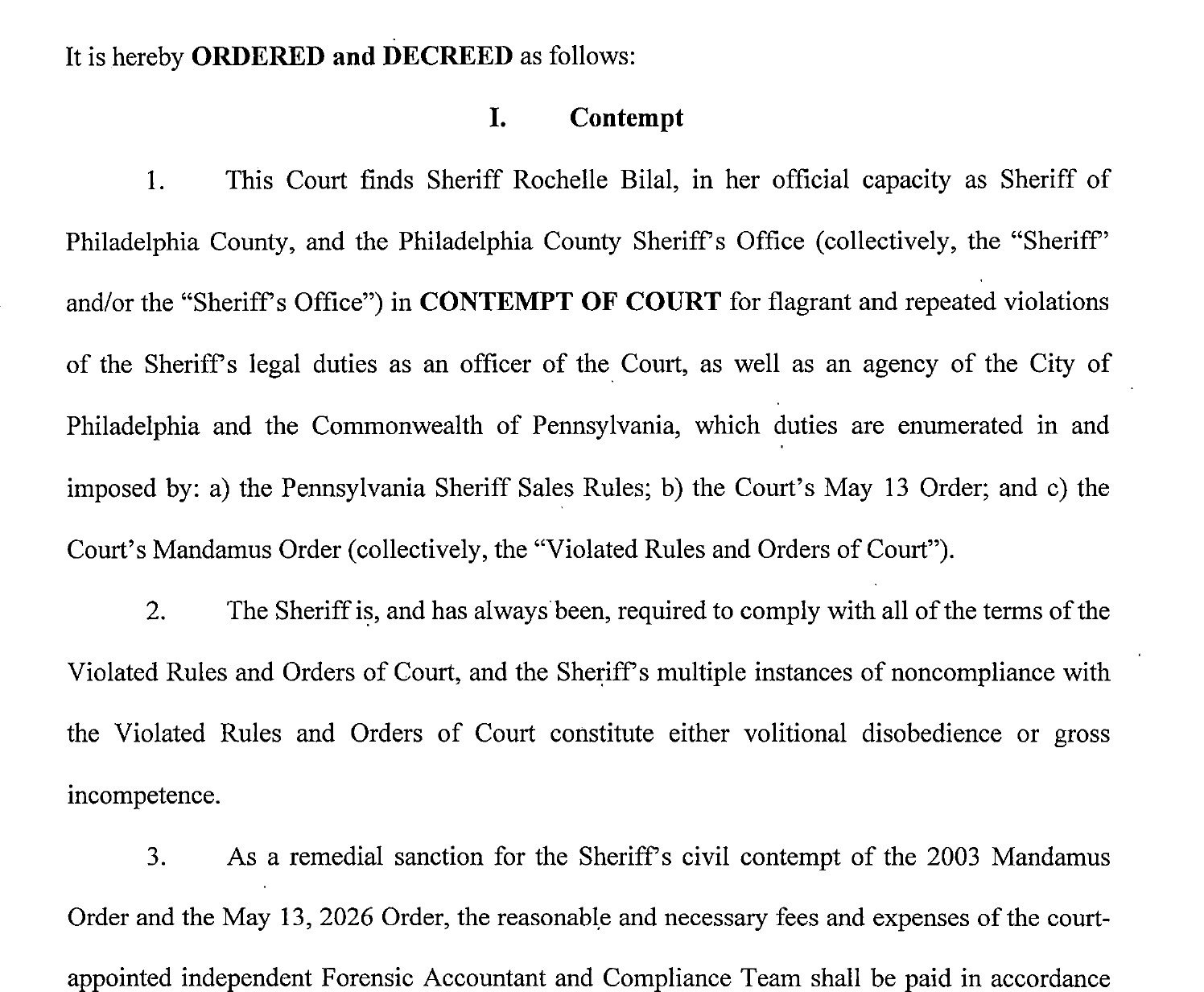
The numbers came from the office itself. An internal audit found at least $20 million in undistributed sheriff-sale proceeds, including tax money owed to the city. A list the office filed held 2,039 outstanding checks totalling $120,009,315.37, dated from September 6, 2024 to August 21, 2026 — and Deputy Undersheriff Steven Wakefield could not explain them to the court. Bilal fought an outside audit for months and said the problems had been fixed.
Bilal, who previously made headlines attacking ICE, denied wrongdoing and said an internal review found no funds missing. The court did not find that money was stolen.
There is no jail time. The court ordered an independent forensic accountant, chosen by the court, and a compliance team to oversee the office, and City Council now takes its turn: councillors authorised their own inquiry on November 12 under Resolution 260983, and the Committee of the Whole sits on December 7 at 1 p.m. in Room 400 of City Hall. What happens next is the audit — an outside accountant tracing where the sale money actually went.