Canada is raising the maximum Employment Insurance payment to $749 a week for 2027, up from $729 this year, because the maximum insurable earnings — the income ceiling that EI is calculated on — rises to $70,800 from $68,900. The figures are set out in the federal government's summary of the 2027 actuarial report on the EI premium rate, published by Employment and Social Development Canada.
Why it matters: EI is the income a worker falls back on after losing a job through no fault of their own, paid at 55 percent of average insurable earnings. The ceiling decides the most anyone can draw — at the new maximum, nearly $3,000 over four weeks. But the same report raises what workers pay in: the EI premium goes up a cent, to $1.64 for every $100 of earnings.
The report's own table puts the full cost this way: a worker pays at most $1,161.12 in 2027, which is $38.05 more than in 2026, and employers pay 1.4 times the worker's rate — $2.30 per $100, at most $1,625.57 for each employee. Workers in Quebec pay $1.29 per $100, at most $913.32, because Quebec runs its own parental insurance plan beside the federal one. Extended parental benefits top out at $449 a week, up from $437.
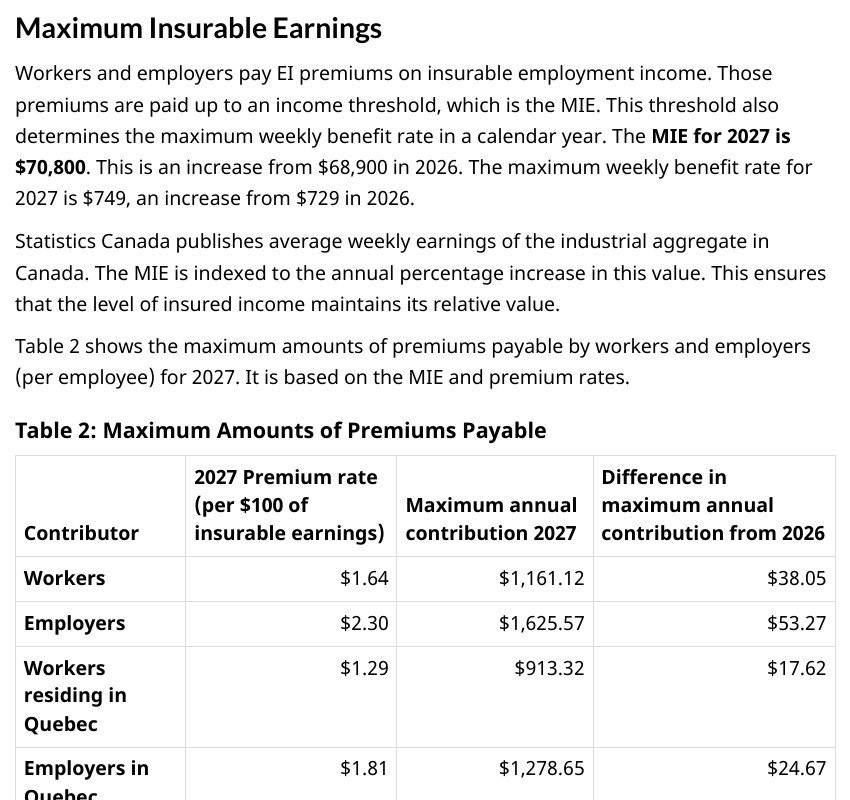
Not everyone who claims will see $749. That figure is the ceiling, reached only by a claimant whose average insurable weekly earnings come to about $1,361.54 — the $70,800 ceiling divided by 52 weeks — across their best weeks of work. Most claimants earned less, and their payment, at 55 percent of their own earnings, comes out below the maximum.
The change in one view: in 2026 the ceiling is $68,900, the top payment $729 and the premium $1.63 per $100; in 2027 those become $70,800, $749 and $1.64. The higher benefit maximum applies to claims beginning on or after December 27, 2026, and the new premium rate and earnings ceiling take effect on January 1, 2027.
The rates are now set for the year. Workers will see the extra cent per $100 come off their January paycheques, and anyone laid off in 2027 will claim under the higher ceiling — worth up to $20 more a week than the same claim would pay today.