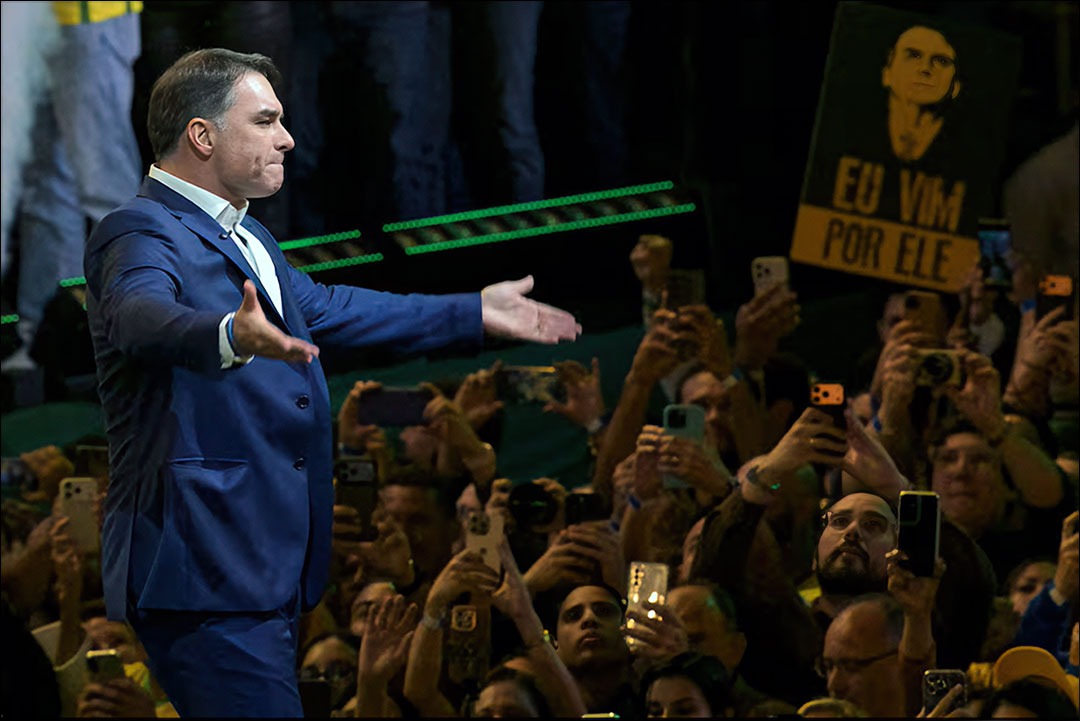
Flávio Bolsonaro told supporters at a campaign event in São Paulo on Tuesday that El Salvador's celebrated crime crackdown does not go far enough for Brazil. "I think El Salvador is not enough," the Liberal Party (PL) candidate said, twelve days before he faces President Luiz Inácio Lula da Silva in the October 25 presidential runoff.
The package he laid out starts with more than 500,000 new places in Brazil's prison system. It adds chemical castration for those convicted of sexual crimes, raises the minimum sentence for cell-phone theft to eight years, and requires prisoners to work. Bolsonaro said he is working on the measures with federal deputy Guilherme Derrite, one of the authors of his "Brazil Without Fear" security plan, drawn up with Senator Sérgio Moro. The plan also calls for five maximum-security mega-prisons modeled on El Salvador's CECOT, criminal responsibility from age 14 for heinous crimes, and an end to parole for violent crimes against women.
"I think El Salvador is not enough."
The model he wants to outdo is President Nayib Bukele's. El Salvador has lived under a state of exception since 2022, with mass incarceration of suspected gang members — and its homicide rate, once among the worst on earth, has collapsed. Bolsonaro has seen it up close: he toured the 40,000-capacity CECOT mega-prison, met Bukele's security minister in August, and said then that Brazil has "too few prisoners" because its laws are too lax. International rights organizations accuse Bukele's government of abuses under the crackdown, a charge his supporters dismiss against the collapse in gang violence. Across Latin America, right-wing candidates have won in Colombia and Peru campaigning on the same promise.
The stakes are set by the first round. On October 4, Bolsonaro took about 47% of valid votes — 56.1 million — against 45.2%, or 53.8 million, for Lula. Brazil requires more than 50% to win outright, so the top two advance to the runoff. Bolsonaro's PL also emerged as the largest force in both houses of Congress, and the wider right holds a Senate majority. Argentina's Javier Milei called his first-round lead historic, Israel's Benjamin Netanyahu wished him luck in the final, and President Trump met him earlier this year.
Lula's side is running the opposite argument on crime. The president has opposed designating Brazil's biggest gangs, the PCC and the Red Command, as terrorist organizations, preferring to attack their finances — a position Bolsonaro attacks head-on, saying Lula "is afraid to confront criminal factions." Lula launched the runoff calling it a new campaign and promising to expose his rival's "dark past," pointing to corruption allegations Bolsonaro denies.
The two men meet again on October 25, and Bolsonaro is not moderating his pitch. "More prisons, fewer criminals on the loose," he vowed when he unveiled the plan.
Never miss a story.
Join our Telegram channel and get every article link the second it’s published.
Join Telegram Channel