
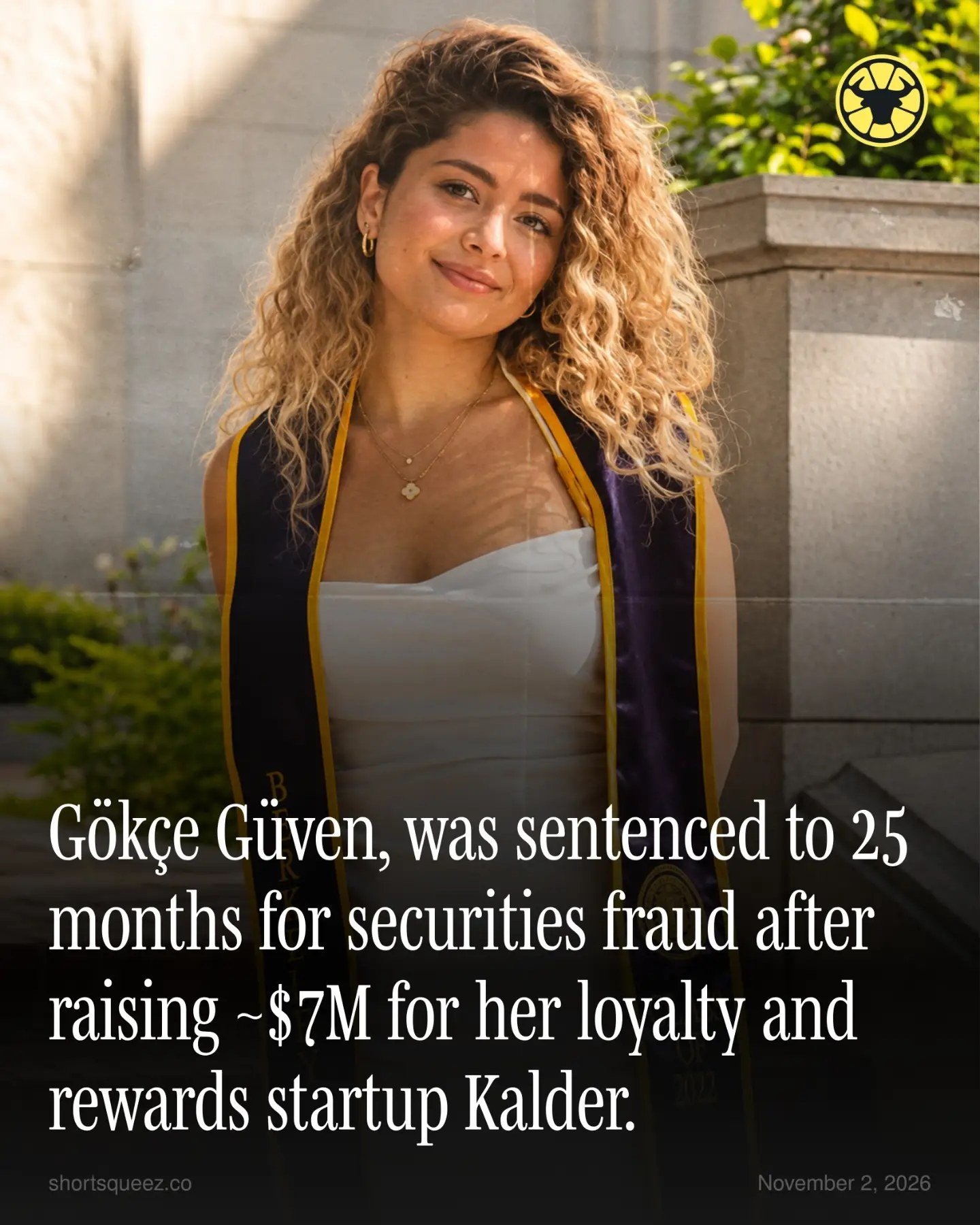
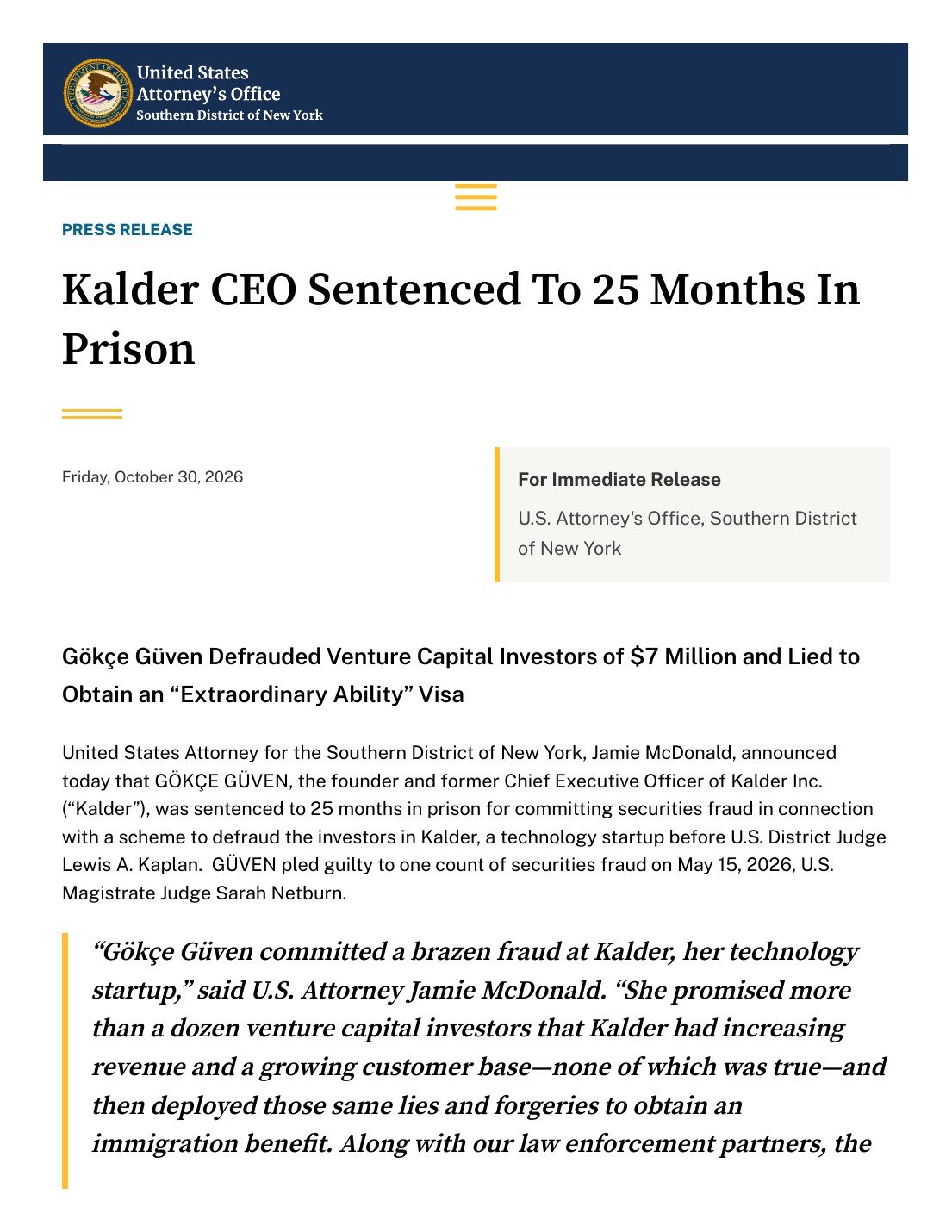
Gökçe Güven, the 27-year-old founder of the New York startup Kalder who was celebrated on the Forbes 30 Under 30 list, has been sentenced to 25 months in federal prison for securities fraud — she raised about $7 million from more than a dozen venture investors on fabricated revenue, invented customers and forged documents, and must now forfeit $6,717,997 and pay the same again in restitution to her victims. Judge Lewis A. Kaplan imposed the sentence on October 30; Güven had pleaded guilty to one count of securities fraud on May 15.
Why it matters: venture money is not Monopoly money — it is pension and retirement savings looking for honest builders, and every dollar stolen by a fake founder is a dollar an honest one never sees. U.S. Attorney Jamie McDonald put the case plainly: "Gökçe Güven committed a brazen fraud at Kalder, her technology startup. She promised more than a dozen venture capital investors that Kalder had increasing revenue and a growing customer base — none of which was true."
The pitch was the fraud. Kalder sold loyalty and rewards programs to brands, and Güven's deck claimed 26 brands were "using Kalder" and 53 more were in "live freemium," with recurring revenue climbing month over month to $1.2 million a year. Prosecutors say some of those brands had only short, heavily discounted pilot deals — and others had no agreement with Kalder at all. She kept two sets of books: the accurate set her outside accountants prepared, and an inflated set she sent investors. She also sent them a forged contract with a brand partner.
The same lies bought her a life in America. After her student visa expired, Kalder sponsored her for an O-1A visa — the "extraordinary ability" visa — on an application repeating the fabricated claims, with reference letters from business executives that prosecutors say she digitally signed herself, without their knowledge. The visa was issued in the fall of 2025. It has since been revoked.

Güven's case now moves to prison and to the SEC's separate civil action, which seeks to bar her from serving as an officer or director. The Forbes list that made her name carries no charge — but her sentencing is one more entry in a line of 30 Under 30 founders whose celebrated numbers turned out to be written by themselves.