Prime Minister Mark Carney sat down in Ottawa on Monday with nearly 200 First Nations chiefs and leaders and the premiers of Canada's provinces and territories — the first time the country's top political leaders have met this way in two decades — and launched talks on a First Nations Sovereign Wealth Fund that would give Indigenous peoples a direct ownership stake in the mines, pipelines and other major projects Canada is racing to build. First Nations are the Indigenous peoples who lived in Canada long before European settlement and whose rights are recognized in the country's constitution, and the premiers are the leaders of its provincial and territorial governments, roughly the Canadian equivalent of U.S. governors. The leaders, seated in a circle behind closed doors at the John G. Diefenbaker Building on Sussex Drive, last gathered in this format in 2005, when then-prime minister Paul Martin hosted talks in Kelowna, British Columbia. Carney called the 21-year gap "sobering" and told the room the meeting had to be about more than listening: "This is an important opportunity, yes, to share perspectives, to listen, to learn, but above all to commit to action."
The centrepiece is money — specifically, who owns a share of Canada's next building boom. The leaders agreed to develop new revenue-sharing mechanisms, including the potential creation of the First Nations Sovereign Wealth Fund, an investment fund that would pool capital and hold stakes in major projects so that the returns flow back to First Nations communities for generations instead of ending when construction does. The idea came from First Nations themselves: the Assembly of First Nations, the national body representing First Nations governments, proposed in a position paper circulated before the meeting that governments jointly create a fund controlled by First Nations and paid for in part by ongoing contributions from projects of national interest, and the Chippewas of the Thames First Nation had earlier put forward a version of the same plan — its chief, Joe Miskokomon, has argued that pooling capital would let communities build long-term wealth, exercise more authority over investments and get major projects developed faster. Carney directed his finance minister, François-Philippe Champagne, to work with First Nations leaders on how to establish the fund, saying the goal is to give First Nations peoples and their children and grandchildren a direct share in the wealth the country creates. No size, ownership structure or start date for the fund was announced on Monday — how it would be capitalized, who would govern it and how returns would be divided all remain to be designed.
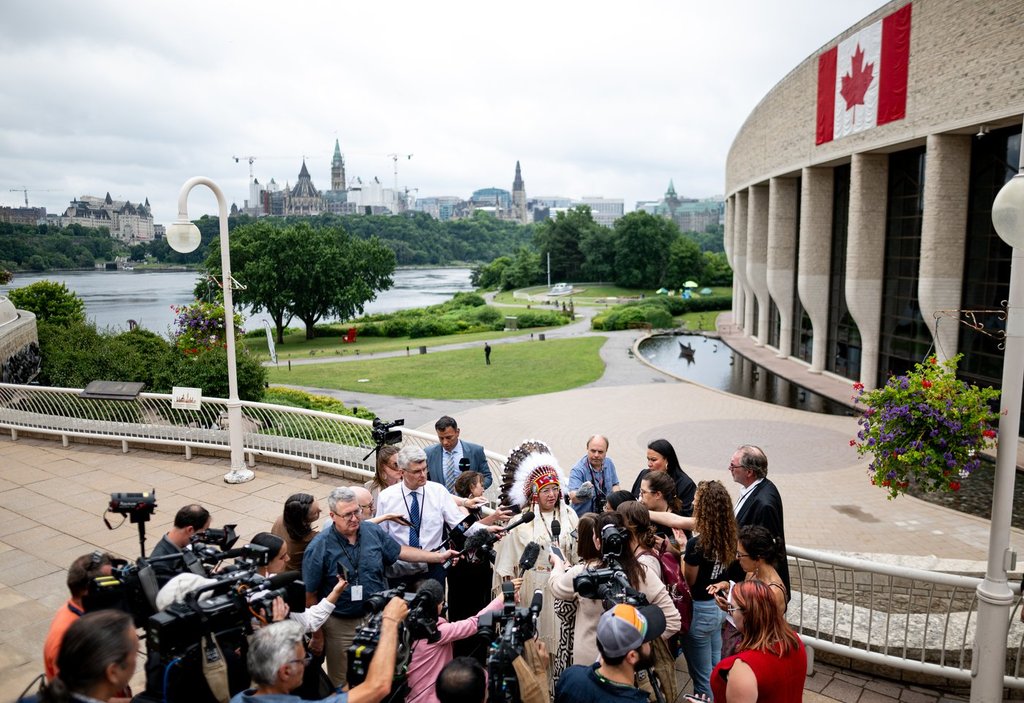
A First Nations leader speaks to reporters in Ottawa.
The training money was firmer. Ottawa announced $260 million over four years to establish a new Partnerships for Indigenous Workforce Readiness Fund, targeted funding meant to connect Indigenous workers with the jobs created by major projects, alongside an Indigenous-focused stream of the government's $8 billion Team Canada Strong initiative, which is designed to move Indigenous workers into paid, entry-level trades jobs and onto job sites faster. The federal government also said it will amend the First Nations Fiscal Management Act to expand the lending authority of the First Nations Finance Authority, a change Ottawa says will make it easier for First Nations to borrow the money they need to buy into major projects and share in the returns rather than only hosting them.
Two larger cheques were aimed at safety on reserves — the lands set aside for First Nations communities. Carney announced more than $2.5 billion over five years, plus nearly $450 million in ongoing funding, for emergency preparedness in First Nations communities, covering evacuations, wildfire fighting and the rebuilding of homes and critical infrastructure after disasters, and more than $630 million over four years, alongside $250 million a year in ongoing funding, to renew and expand the agreements that fund First Nations and Inuit policing. A further $140 million over four years will go to crime prevention and community safety programs in Indigenous communities. The announcements build on existing federal commitments Ottawa lists at $3.5 billion a year for on-reserve education, more than $4 billion for Indigenous housing and more than $4.5 billion committed to clean drinking water on reserves.
The most politically charged discussion was about the Indian Act, the 1876 law that still governs much of First Nations life in Canada, from who holds legal "status" as an Indian to how reserve land can be used. Manitoba Premier Wab Kinew, himself a First Nations citizen, held up his Indian status card in the room and said, "It's time to abolish the Indian Act." Carney said he shares Kinew's view that the time has come to reform or even abolish the law and would direct his ministers to work in partnership with First Nations on a path forward, saying the answer "could be moving beyond, it could be reforming, it could be abolishing." Assembly of First Nations National Chief Cindy Woodhouse Nepinak was more cautious, noting that the act also contains protections for First Nations and that with First Nations holding a diversity of views from coast to coast, the decision on how to move forward belongs to them.
Woodhouse Nepinak opened the meeting by setting the terms on which First Nations would judge it. The gathering, she said, was about building prosperity and well-being for the next seven generations, and "it can't just be about ramming through major projects as fast as we can." The national interest, she said, "must also include the proposals, law, and policy reforms that First Nations seek. We have been persistent and patient, but we cannot afford to wait many, many years for results and implementation." Chief Sheldon Sunshine of Sturgeon Lake Cree Nation in northern Alberta put the same test to the premiers and the prime minister directly: "History will not remember us for gathering in a room, taking photographs, making speeches. History will judge us by what we change." After the meeting, Woodhouse Nepinak told reporters she was happy with the day and with the tangible commitments secured.
Not everyone left persuaded. Cody Diabo, grand chief of the Mohawk Council of Kahnawà:ke, walked out early, dismissing the meeting as all "butterflies and rainbows" and not about big-picture substantive issues, while Hereditary Chief Na'Moks of the Wet'suwet'en Nation in British Columbia said the gathering felt like a search for "cheerleaders" for the federal agenda. Around 40 protesters gathered outside, and Russell Diabo, a longtime First Nations policy analyst, argued Ottawa should change how it deals with First Nations instead of working through bodies it funds, such as the Assembly of First Nations. Abram Benedict, the AFN's Ontario regional chief, said he felt good about the investments and the potential wealth fund, but noted the AFN had asked for these meetings to be held every year and got no commitment — "There seems to be a willingness, but there was no commitment," he said. Carney suggested the right timeline for the next meeting is probably two years. Three premiers missed the meeting altogether: Alberta's Danielle Smith and Quebec's Paul St-Pierre Plamondon cited other commitments, and British Columbia's David Eby, who lost a provincial election on the weekend, was not expected in Ottawa.
The meeting fulfils a promise Carney made in December 2025, when he committed to the Assembly of First Nations that he would convene the country's first ministers with First Nations leaders in 2026, and it lands just days before his government's federal budget on November 5 — a budget the AFN says will be a big test of Carney's record. It also lands in the middle of Carney's push to build faster: his government has already passed one law to speed approvals for select major projects, and a second bill now before Parliament would give all new projects a single federal review and a decision within a year, timelines Woodhouse Nepinak has warned may be too tight to allow proper consultation with the First Nations whose lands and rights those projects cross. For Canada, the stakes are straightforward. As the country tries to diversify its economy under pressure from U.S. tariffs by building mines, pipelines, ports and power projects at a pace it has not attempted in a generation, almost all of that construction runs through territory where First Nations hold constitutionally protected rights. Monday's message from Ottawa was that the fastest route to building is not to go around them, but to cut them in — as workers, as lenders, and, if the wealth fund takes shape, as owners.
📣 Join ProfiloPolitics on Telegram — breaking news first
Follow @profilopoliticsnews for every update on this story.