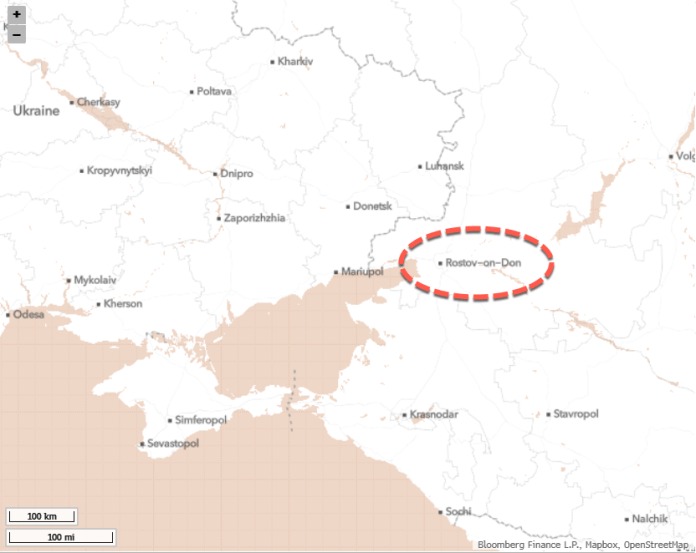
The timing was no accident. Late Friday night, just hours after President Donald Trump announced on social media that he had struck a diesel supply deal with Russian President Vladimir Putin, explosions ripped through the Russian city of Rostov-on-Don. By 3:36 a.m. local time, Rostov Governor Yuri Slyusar was on Telegram saying air defenses were repelling an aerial attack and that a fire had broken out in the city. By morning the scale was clear: more than 100 Ukrainian drones had been destroyed or suppressed across the region, six people were injured — two of them seriously — apartment buildings and homes were damaged, a railway bridge was hit hard enough to halt train traffic in both directions, and two vessels were damaged at the port of Azov.
The centerpiece of the night, according to geolocation of eyewitness video by the Russian independent outlet ASTRA, was the Yug Rusi oil-loading terminal — the Rostov branch of the Novoshakhtinsk refinery, also known as the NZNP terminal — burning in the city's Zheleznodorozhny district. Footage posted online showed a towering fireball and thick black smoke over the facility through the night.
This is no small target. The terminal transships petroleum products for export, supplies fuel to the Russian military, and earns Moscow foreign currency. ASTRA puts its design capacity at about 2.5 million metric tonnes a year; the company itself lists 3.5 million tonnes of receiving and shipping capacity. Ukraine has hit it before — Ukrainian forces struck the terminal on July 9, 2026, and hit the Novoshakhtinsk refinery's facilities again in September. Kyiv's logic is simple and has not changed: every barrel that cannot move is money Moscow cannot spend on the war.
The problem, from Washington's view, is that those burning barrels are also the fuel the world is desperate for — and the exact diesel Trump is trying to unlock for Americans. On Friday, after a phone call with Putin that was supposed to be about a suspected plague outbreak in Russia, Trump announced instead that Moscow would immediately supply more than 300,000 tons of diesel, followed by 500,000 tons in November, 1 million tons "immediately thereafter," and another 3 million tons "within a short period of time." Putin confirmed Russia was ready to supply oil and petroleum products to American and global markets. The Treasury issued a temporary license to let it happen. "Lower prices for Americans, especially our Great Farmers, Ranchers, and Truckers, is my Greatest Priority," Trump wrote.
He did not arrive at this deal out of nowhere. The administration had been asking Kyiv to lay off Russia's refineries for months — a U.S. official said Trump had been fuming at Zelensky over the refinery campaign and that Washington asked Ukraine to halt the strikes repeatedly, to no avail, with Axios reporting half a dozen requests. Diesel is running about $6.28 a gallon nationally, and diesel futures fell about 4 percent on Friday on the deal news. The announcement even landed while Trump's envoys Steve Witkoff and Jared Kushner were sitting with Ukrainian officials in Miami — a meeting that ended early, with Kyiv's team blindsided. On Saturday Trump told reporters Ukraine should get "a new leader who can make a deal," saying Zelensky could have settled the war many times and chose not to.
Zelensky is not backing down. He called the diesel arrangement "a weak decision, unfortunately, a weak decision by strong partners," warning that easing sanctions on Russia would only prolong the war — and a senior Ukrainian official told the Financial Times the refinery campaign would continue. Zelensky's one offer is reciprocity: Ukraine will stop hitting Russia's energy infrastructure if Russia stops hitting Ukraine's. Moscow, meanwhile, answered the night with its own bombs — Russian strikes on Zaporizhzhia killed at least 11 people, including three children, according to the Associated Press.
The White House has made no on-record comment about the Rostov strike itself. Markets reopen with diesel prices still above $6 a gallon, and the first tanker loadings will show whether Trump's diesel deal can survive a war that keeps setting refineries on fire.