The Quad summit this page announced on Saturday has now happened: President Trump sat down in Manila on Tuesday with India's Narendra Modi, Japan's Sanae Takaichi and Australia's Anthony Albanese — the first in-person Quad leaders' summit since 2024, and the first ever held in a non-Quad country — and it produced hard outcomes: new critical minerals deals between the four nations, a new joint maritime patrol aircraft exercise, a first Quad Business Leaders Forum set for 2027, and a public promise from Trump that the four will match China's rare-earth supply within 10 months.
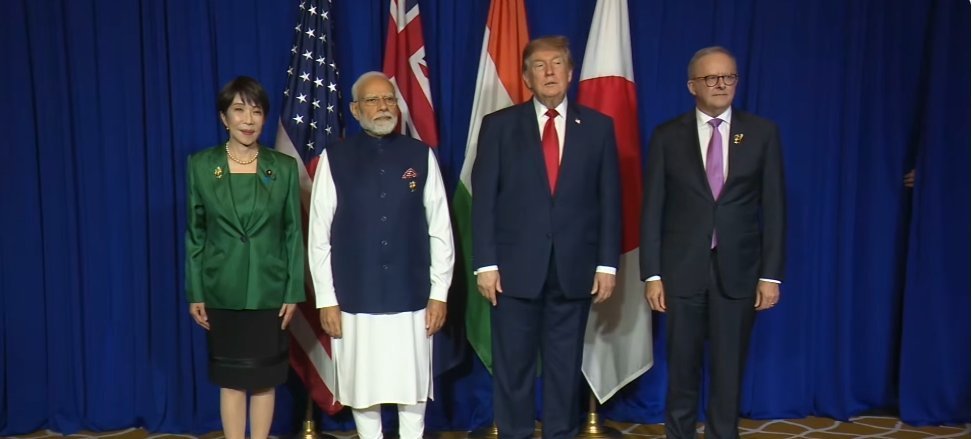
Why it matters: rare earths are the chokehold China holds over the modern world — they go into phones, electric cars, fighter jets and missiles, and Beijing has already shown it will squeeze supply for leverage. If the four democracies can mine, process and supply their own, American factories and the U.S. military stop depending on a rival's permission. That is the promise Trump has now made, in front of the three partners America needs in order to keep it.
Trump's own words, to reporters standing alongside the leaders: "We're doing very well. We are making rare earth at a level that we've never made before. We're gonna catch them within 10 months. Everything that we need, we'll have in 10 months. We're producing major numbers when it comes to rare earth, and they are too, by the way. Japan is, India is, we are all doing it." He called the ties between the four nations "phenomenal," called Modi "a very tough man" — and said Takaichi "may be even tougher."
At the meeting, Trump announced new critical minerals agreements between the United States, Japan, India and Australia, and a new maritime patrol aircraft exercise that brings the four nations' patrol planes together over the Indo-Pacific's contested waters. Albanese announced the first Quad Business Leaders Forum, scheduled for 2027, to turn the governments' decisions into private investment. Modi pressed the group to deliver concrete goals on maritime security, supply chains, emerging technologies and disaster response. The leaders also put their own names to the technology accelerator and the more than $85 million for access to trusted "superintelligence" systems across the Indo-Pacific — money the four foreign ministers had already agreed in October, now carried at leaders' level.
The sequence is the strategy. On Tuesday, Trump locked in America's three Indo-Pacific partners — their minerals, their patrol planes, their business leaders. On Thursday, in Shenzhen, he sits down with Xi Jinping and Vladimir Putin, carrying all of it into the room. The rare-earths claim is now on the record with a deadline attached: ten months. The clock is running, and the four nations will be measured against his words.
— — —
President Trump will sit down with the leaders of the Quad — India, Japan and Australia — in Manila on Tuesday, the White House has confirmed, opening his Asia trip with the four-nation partnership built to keep the Indo-Pacific free and open before he flies on to Shenzhen for his meetings with Xi Jinping and Vladimir Putin.
Why it matters: the Quad is America’s working bloc in the region China is trying to dominate — the United States, India, Japan and Australia coordinating on maritime security, critical minerals, energy and disaster response. Putting the Quad meeting first on the trip, in the capital of a treaty ally facing Chinese pressure in the South China Sea, is the administration’s signal of the week: before Trump sits with Xi and Putin, he sits with America’s partners.
The White House laid the meeting out in its own words in a pre-trip briefing by Assistant Press Secretary Olivia Wales. "In Manila, the president will participate in a multilateral meeting with Quad leaders to discuss shared interests of peace, prosperity, and security in the Indo-Pacific region," Wales told reporters, adding the administration’s own description of what the group has become: "Under President Trump’s leadership, the Quad has demonstrated that it is a partnership of action, tackling the region’s toughest challenges and driving opportunities to ensure a free and open Indo-Pacific."
The Manila schedule around the meeting is packed. Trump leaves Washington early Monday and lands in Manila Tuesday evening local time. After the Quad meeting he signs a trade deal with Thailand, takes part in the U.S.-ASEAN special summit, and is guest of honor at a dinner with ASEAN and other regional leaders. Wednesday brings the state welcome at the presidential palace with President Ferdinand Marcos Jr., a bilateral meeting and lunch banquet, and commercial deals and strategic investments across aviation, defense, energy and technology — then the APEC leaders' dinner before the flight to Shenzhen.
Two honest limits came with the briefing. The White House announced no specific agreements expected from the Quad discussions, and it did not announce a separate bilateral meeting between Trump and India's Prime Minister Narendra Modi — Modi will be at the Quad table, but no one-on-one was listed. Reuters, citing sources, likewise reports the leaders' meeting for Tuesday in Manila.
The situation now: the trip runs Monday to Thursday — Manila first, with the Quad, ASEAN and the Marcos state welcome, then Shenzhen for the APEC meetings, the Xi bilateral and working lunch, and the first-ever trilateral with Xi and Putin to close. The Quad meeting is where the week's message gets set: the partnership of action, gathered in Manila, before the hard conversations in China begin.
Tuesday, November 17, 2026
Trump announced more than $85 million in spending and a new technology accelerator to expand access to trusted "superintelligence" systems across the Indo-Pacific when the four leaders met in Manila on Tuesday, the first Quad leaders' summit in two years and the first of his second term. He also announced new critical minerals agreements between the four countries, a new maritime patrol aircraft exercise and the first Quad Business Leaders Forum, scheduled for 2027, to strengthen economic cooperation between the four countries.
For the four countries, the package is aimed at the supply chains China dominates — the minerals, chips and AI systems the region runs on. Australian Prime Minister Anthony Albanese, speaking at the meeting, highlighted critical minerals, rare earths, artificial intelligence and maritime security as the priorities for cooperation. The spending and the accelerator were first set out in the Quad foreign ministers' joint statement in Atlanta on October 31, which also welcomed a separate $10 million American commitment to build facilities in India and ASEAN countries for recovering critical minerals from waste; Trump put the package forward again at the leaders' table in Manila.
What happens next is delivery. The export credit agencies of the four countries are to meet in Tokyo on November 18, and the first Quad Business Leaders' Forum is set for 2027. The leaders' meeting closed the Manila leg of Trump's Asia trip before he flies to Shenzhen for the APEC meetings and the first-ever trilateral with Xi Jinping and Vladimir Putin.