No president appointed Matthew J. Sharbaugh, and the Senate never voted on him. Sharbaugh is a United States magistrate judge, and magistrate judges are not chosen in Washington's usual way — under federal law, the judges of the district court pick them. In Sharbaugh's case, the judges of the U.S. District Court for the District of Columbia selected him in October 2024, after a screening process run by a merit panel, and Chief Judge James E. Boasberg swore him in for an eight-year term.
That is the answer to the question readers have been asking since federal agents searched Rep. Ilhan Omar's Washington home on October 12. Sharbaugh was the magistrate judge on criminal duty from October 3 through October 16, the window that covered the search, and reporting by CNN and others identifies him as the judge who approved the warrant — after first limiting how the Justice Department could handle Omar's congressional documents. The warrant itself remains sealed, so his role rests on the court's duty roster and that reporting, not on a released court document.
The selection worked the way it works for every magistrate judge in America. A merit selection panel — lawyers and community members appointed by the court — screened the applicants and recommended finalists, and the court's active judges then made the appointment by majority vote. The D.C. court's own announcement of his swearing-in put it plainly:
"He was selected by the Court following a comprehensive selection process." — U.S. District Court for the District of Columbia, October 28, 2024
One detail of that process cuts against the way the story is often told: the merit panel that screened Sharbaugh's application was chaired by Jessie Liu, who served as President Donald Trump's U.S. Attorney for the District of Columbia. Boasberg's part was the oath — administering it is the chief judge's ceremonial job, not an appointment. Sharbaugh took the seat in Courtroom 7 of the E. Barrett Prettyman Courthouse left open when Magistrate Judge Robin M. Meriweather was appointed to the U.S. Court of Federal Claims, and his eight-year term, unlike a district judge's lifetime seat, can be renewed or ended by the same judges who gave it to him.
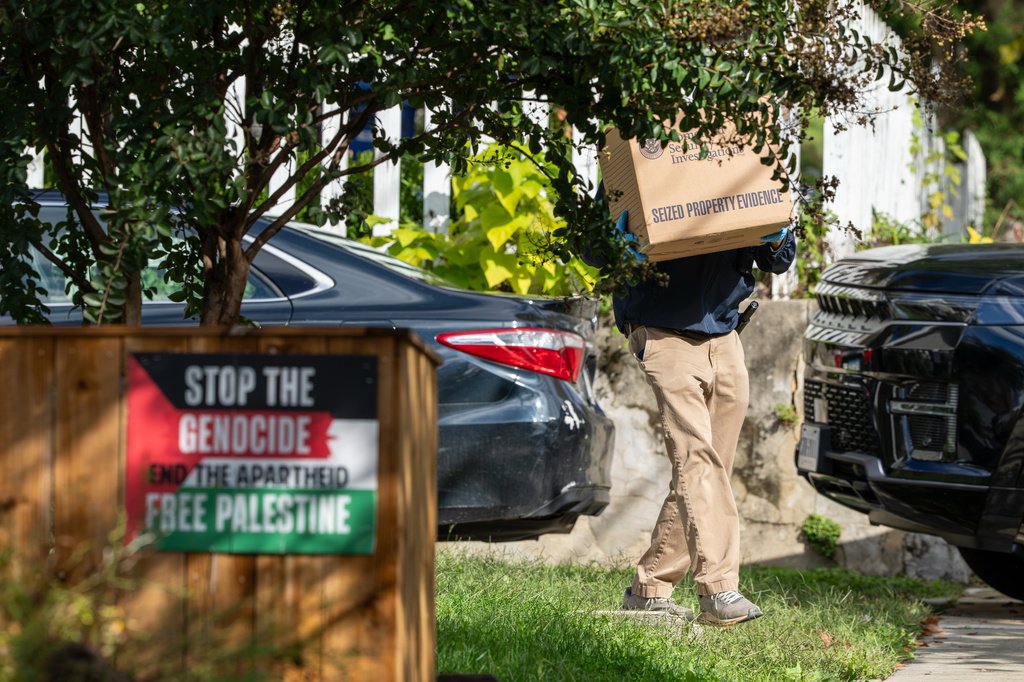
A federal agent carries a box marked "Seized Property Evidence" out of Rep. Ilhan Omar's Washington residence during the October 12 search carried out under the warrant. (AP Photo/J. Scott Applewhite)
So where does the "Democratic appointee" label come from? Legal scholar Jonathan Turley, who first drew attention to Sharbaugh's background, described him as "a registered Democrat and a Democratic appointee" and "a Hillary Clinton donor, who was sworn in by Judge James Boasberg." The personal record behind the label is documented: Federal Election Commission filings show Sharbaugh, then a Morgan Lewis attorney, gave $250 to Hillary for America in October 2015 and further contributions to the Hillary Victory Fund in 2016, and later filings connect the same donor to Joe Biden, Jon Ossoff and Raphael Warnock. And the court that picked him is a bench where most of the active judges were themselves appointed by Democratic presidents — which is why the label sticks politically, even though no Democratic president, and no president at all, ever sent his name to the Senate.
His path to that bench ran through music before law. Born and raised in Wilmington, Delaware, Sharbaugh earned a Bachelor of Music, summa cum laude, from Berklee College of Music in 2004, then a law degree, summa cum laude, from Pepperdine University School of Law, where he was managing editor of the Pepperdine Law Review. He started at Littler Mendelson in Los Angeles, clerked twice for Judge Robert L. Wilkins — an Obama appointee — first on the district court and again after Wilkins rose to the D.C. Circuit, and, according to his court biography, prosecuted public-corruption and campaign-finance cases in the Justice Department's Public Integrity Section before becoming a partner at Morgan, Lewis & Bockius in Washington. He also taught legal research and writing at George Washington University Law School.
What he did with the Omar application matters as much as who picked him. The Washington Post reported that Sharbaugh imposed protections tied to the Constitution's Speech or Debate Clause — the shield for lawmakers' legislative work — before he would authorize the search, and CNN reported that prosecutors had to accept limits on how they could access Omar's documents. Omar's lawyers now allege the agents broke those limits during the search; the Justice Department says its people complied with every court order. News organizations have asked the court to unseal the warrant so the public can see what the government showed him. We have reported separately on what the investigation could mean for Omar's seat in Congress.
The stakes run in both directions. Former President Barack Obama accused the Trump administration of targeting Omar because, as he put it, "the government can't selectively target individuals simply because of their political beliefs or what they say." Supporters of the investigation answer with the appointment itself: the judge who found probable cause was no Trump appointee and no Senate-confirmed judge at all, but a Clinton donor chosen by his fellow judges — who still signed, after narrowing the warrant first. As Article III Project founder Mike Davis, who first flagged the duty roster, put it: "Judges do not authorize home raids lightly."