Washington has now answered. Secretary of State Marco Rubio spoke by phone on Monday with Bahrain's Foreign Minister, Abdullatif bin Rashid Al Zayani, and condemned Iran's attacks on Bahrain — reaffirming the commitment of the United States to the security of Bahrain and of all its Gulf partners.
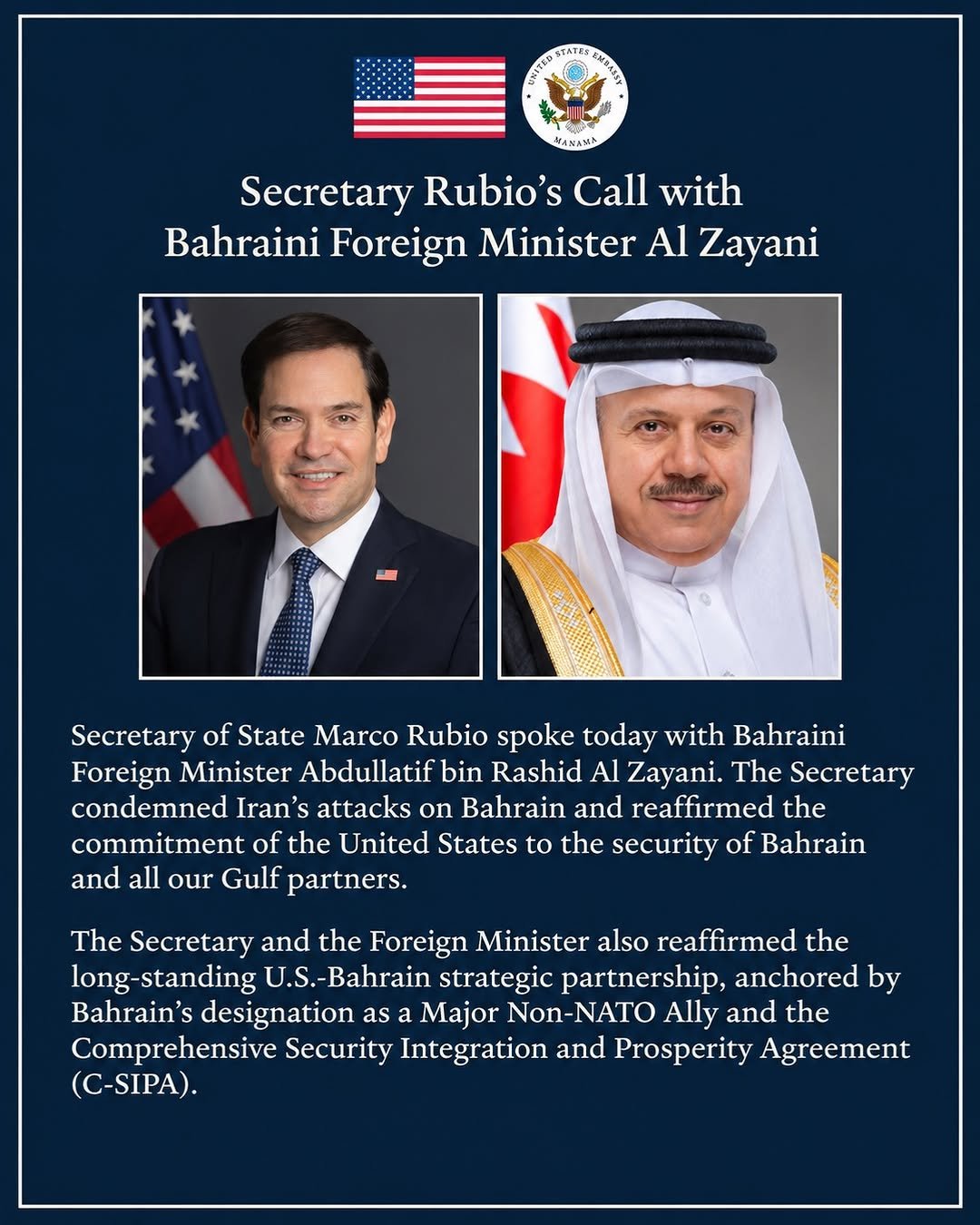
The U.S. Embassy in Manama published the call the same day: "The Secretary condemned Iran's attacks on Bahrain and reaffirmed the commitment of the United States to the security of Bahrain and all our Gulf partners." The two men also reaffirmed the long-standing U.S.–Bahrain strategic partnership, anchored by Bahrain's designation as a Major Non-NATO Ally and the Comprehensive Security Integration and Prosperity Agreement (C-SIPA) — the partnership that keeps the U.S. Navy's Fifth Fleet headquarters in Manama.
Why it matters: Central Command answered Friday's first strike within hours, but Sunday's six drones drew no American comment at all. Rubio's call is Washington's first public answer since — America's name now set publicly behind Bahrain's defence. It did not stop Tuesday's strike at Sheikh Isa, which came the next morning. Whether the commitment is now backed by more than words — more air defence around the Gulf bases Iran keeps targeting — is the part still unanswered.
— What follows is the story as first written · the update is above —
Iran's Revolutionary Guards say their combat drones struck a U.S. radar system at Sheikh Isa Air Base early on Tuesday — the third Iranian attack on Bahrain in five days — and this time the kingdom's Interior Ministry told the whole country to get to the nearest safe place, while Bahrain's air defences intercepted the Iranian attacks and no one has confirmed any damage.
The order of these attacks is the story. Friday's strike was an answer — the Guards said it avenged an attack on a tower inside Iran. Sunday's six drones and Tuesday's strike at Sheikh Isa answered nothing that had just happened: Tehran is opening the exchanges itself now, choosing the mornings, against the small kingdom that hosts the U.S. Navy's Fifth Fleet — pushing Trump to be the one who must decide whether to answer, while American radar crews and Bahraini families live under the sirens.
The Guards said the Sheikh Isa strike answered 'continued violations of Iranian airspace by American drones', and warned that continued use of regional bases for what they called hostile actions against Iran 'would not go unanswered', with U.S. commanders responsible for the consequences. Bahrain's Interior Ministry posted its alert on Tuesday morning: 'An alert of potential threat' — urging citizens and residents to remain calm, proceed to the nearest safe location, and follow news through official channels. The ministry later announced the alert had ended.
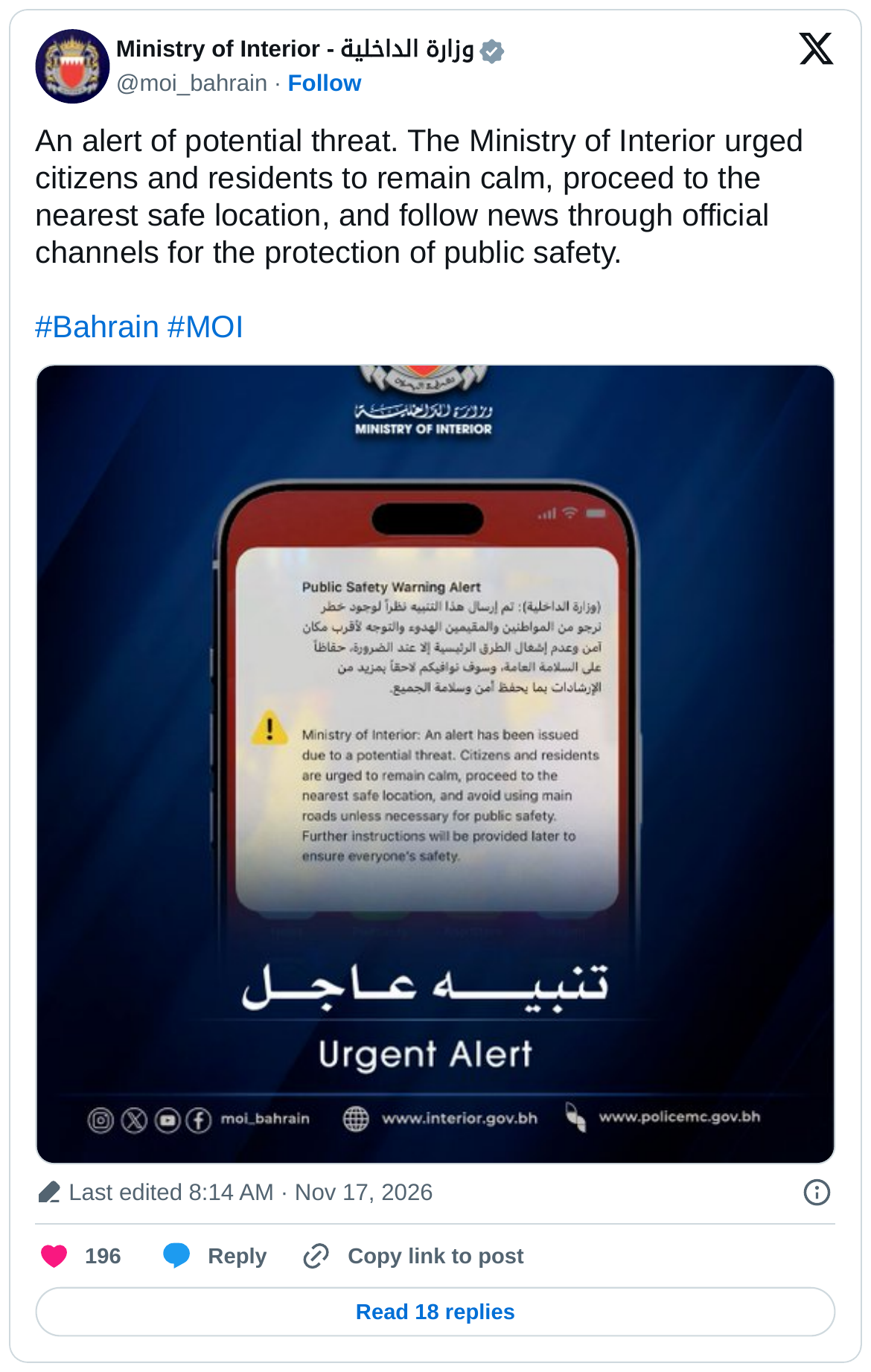
On Friday, Washington answered within hours: Central Command called the Guards' first radar claim false and said two Iranian drones were shot down with no damage. Sunday's attack — six drones at the air defence radar at the al-Riffa helicopter base, two ministry alerts three hours apart from 4:30 in the morning, sirens across the kingdom — drew no American comment at all, while Bahrain's Foreign Ministry called it a 'brutal Iranian attack' and held Iran fully responsible. On Tuesday the pattern repeated: the Guards claim the hit, Bahrain says its defences stopped the attacks before they reached their targets, and the radar's fate is confirmed by neither side.
What happens next turns on Washington. The Guards have now claimed three strikes in five days on the radars that guard America's Gulf bases, each one announced by Tehran before America has spoken, and Manama has twice had to send its people to shelter. Whether Central Command answers Tuesday's claim as it answered Friday's — and whether the United States treats a third attack as the provocation that ends its restraint — is the decision now sitting in front of Trump.
— What follows is the story as first written · the update is above —
Iran's Islamic Revolutionary Guard Corps said on Friday, November 13, that its Aerospace Force "targeted and destroyed" a U.S. early-warning radar in Bahrain. U.S. Central Command called the claim false the same day, saying its forces shot down two Iranian one-way attack drones headed toward Bahrain and that there were no injuries or damage. The radar strike has not been independently confirmed.
In a statement on X, CENTCOM said: "The IRGC launched two one-way attack drones toward Bahrain and both were shot down by U.S. forces. There were no injuries or damage." The command labelled the IRGC's radar-destruction claim false.
The IRGC said the strike was retaliation for an air attack on a telecommunications tower in Sirik, on Iran's southern coast, which Iran's state news agency IRNA reported on Thursday. The Guards called the radar strike "a serious warning" to end what they called aerial provocations and oil smuggling in the Strait of Hormuz, and warned of an unlimited response if the attacks are repeated. The statement was carried by the Guards-affiliated Fars news agency and by Iranian state media. No details were given of the weapons used, the radar's exact location, or any damage or casualties.
Reuters reported it was Iran's first claim of an attack on U.S. military assets in a Gulf country since early September. Bahrain hosts the headquarters of the U.S. Navy's Fifth Fleet. The Associated Press reported that it could not independently verify the claim — nor a separate IRGC account that a liquefied petroleum gas tanker struck a mine in the Strait of Hormuz on Friday.
Nothing in the available reporting confirms that a strike took place, that a radar was hit, or that the earlier Sirik attack was carried out by the United States. This article reports the claim only as a claim, with the U.S. military's denial carried alongside it.