What Is a Talking Filibuster?
A talking filibuster is the old form of the Senate filibuster, in which the senators who want to block a bill have to block it out loud. They must stand on the Senate floor, be recognized to speak, and keep speaking for as long as they want to hold the bill up. While a senator holds the floor, the Senate cannot move to a vote. When nobody is left standing and speaking, debate is over, and the Senate can vote on the bill itself — and a bill passes that vote by a simple majority, not by sixty votes.
The plain reality is that the Senate's own rule book still runs on unlimited debate. The Senate's official history says the right of unlimited debate has been a key part of the chamber since its first session in 1789, and the only formal way to cut debate off is cloture under Rule 22, adopted in 1917 and lowered in 1975 to three-fifths of all senators — sixty of the current one hundred. That is what the record says. What reality shows is different: since the two-track system arrived in the 1970s, a filibustered bill is simply set aside while the Senate does other business, so a filibuster today needs no speech, no floor time and no public defence at all. A bill can be killed by senators who never say a word against it in the chamber.
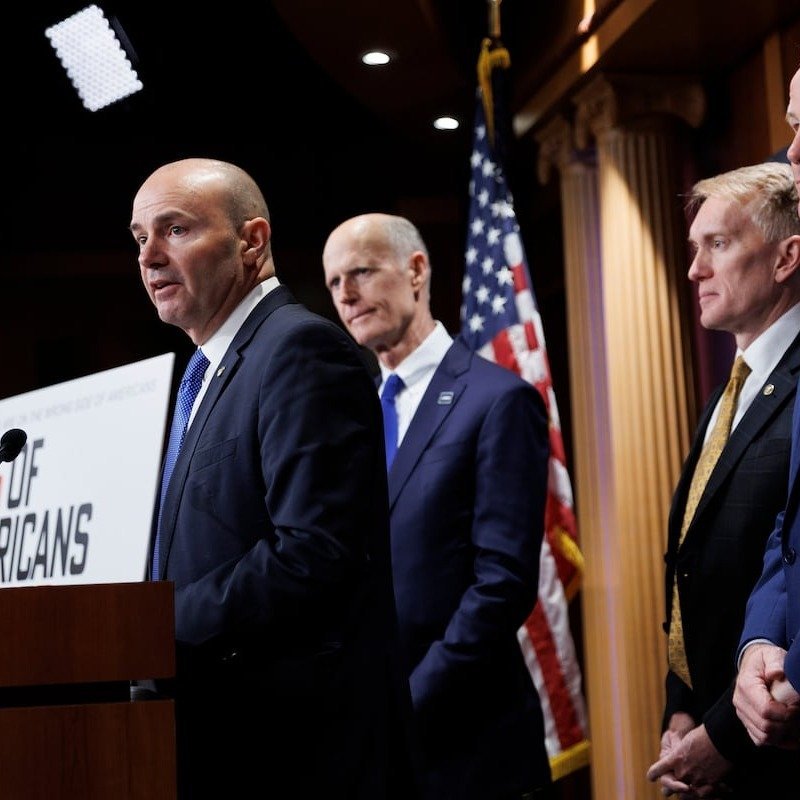
Senator Mike Lee of Utah, who calls that modern version the zombie filibuster, claims the cure is already in the rules and nothing has to be abolished. His demand, repeated with Senator Rick Scott of Florida on Sunday, is to require filibustering senators to speak, call the vote at a simple-majority threshold when they stop speaking, and announce that debate will continue until the bill passes. Lee told Fox News: "All we're asking is that if you want to filibuster this bill, you should have to show up, stand up, seek recognition and speak." Scott's claim is about the clock: Republicans have two months left, every candidate for a leadership job must commit to passing the SAVE America Act, and failure is not an option. Senate Majority Leader John Thune has guaranteed the bill a floor vote, and Minority Leader Chuck Schumer claims the other side of it — Democrats will fight the measure, in his words, "tooth and nail," and will not let it pass in the Senate.
"Over the last few decades, we've made it way too easy to where people can filibuster in their sleep or while on vacation, while at recess, at a bar, whatever. They don't have to show up and speak." — Sen. Mike Lee
Stated plainly, the principle is this: a block that costs nothing will be used on everything. If a senator can stop a bill with a quiet objection, the country never hears the argument against it and never sees who stopped it. If the same senator has to stand in public and talk for hours to keep the block alive, the block has a price, a face and a limit — the limit of a human voice.
The consequence of the free block is already on the record. The SAVE America Act, which would require documentary proof of citizenship to register for federal elections and photo identification to vote, passed the House on February 11 by 218 to 213. In the Senate, Republicans hold fifty-three seats to the Democrats' forty-seven, Lee's own test amendment reached fifty votes with Vice President JD Vance available to break a tie — and the bill still cannot get a final vote, because a cloture vote tied to it failed fifty-three to forty-seven in March, seven votes short of sixty. A majority exists for the bill. No majority is allowed to act on it. Scott and Lee are now pressing Republican leaders to reconvene and force exactly this fight, warning that Republicans have less than sixty days before Democrats take the Senate on January 3.
So the question that follows from the talking filibuster is not really about one election bill. It is this: if senators no longer have to speak to kill a bill, in what sense is the Senate still a place where anything is debated at all?
The details show both why the tactic can work and why it is hard. Speaking has a physical end. The Senate's own history records the longest individual speech as Senator Cory Booker's twenty-five hours and five minutes in April 2025, delivered against the Trump administration's policies — proof that one determined senator can hold a floor for a day, and proof that even the strongest voice runs out. A talking filibuster also costs the majority something real: Republicans would have to keep their own senators present around the clock to hold a quorum and sustain the proceedings, through nights and weekends, while Democrats rotate fresh speakers. That is why Thune has resisted committing to it, telling reporters on an earlier round of this fight: "Show me a path to passage… The Democrats aren't voting for this, I am just telling you. And Republicans are not getting rid of the legislative filibuster." Lee's answer is that his plan gets rid of nothing — it simply refuses to file the cloture motion that lets everyone go home, and lets the debate the rule book describes actually happen, until it ends the way debate used to end, with the speaking finished and the vote called. His words for the whole argument remain the simplest statement of it: "We've made it way too easy to where people can filibuster in their sleep."