Who Is Dakota Meyer?
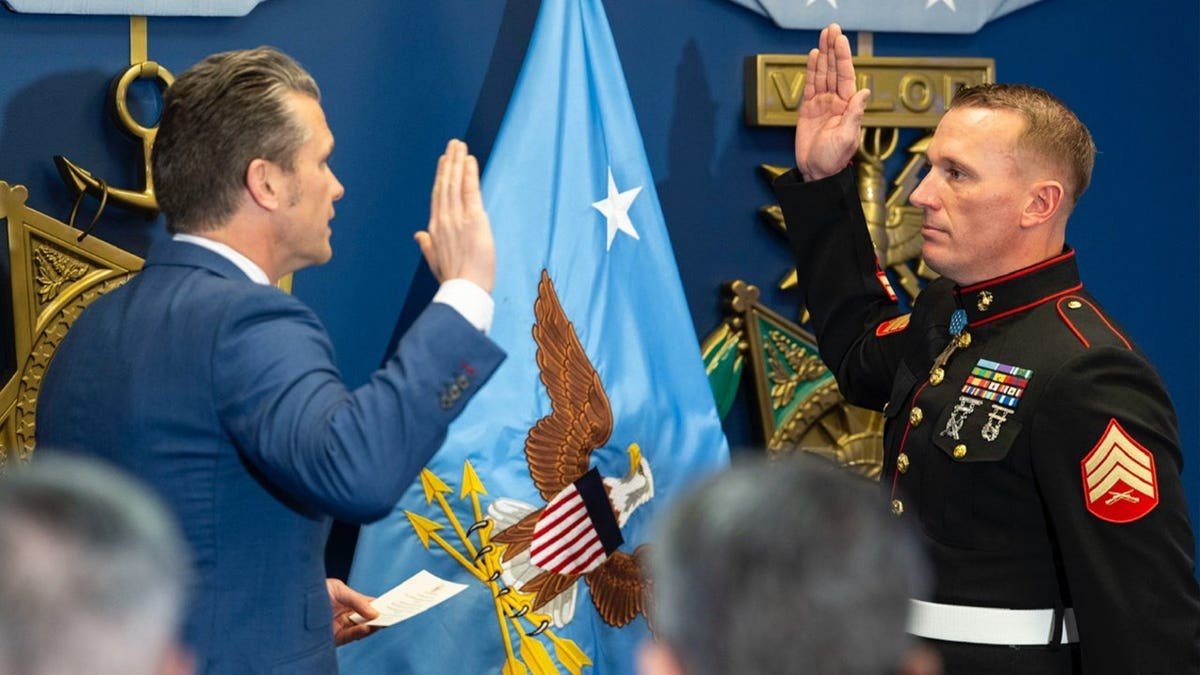
Dakota Meyer is a Marine Corps veteran who was awarded the Medal of Honor, America's highest military decoration, for his actions at the Battle of Ganjgal in Afghanistan in 2009, when he was 21. He is in the news again on Veterans Day for something no Medal of Honor recipient had ever done before him: fifteen years after leaving the Marines, he reenlisted, and at 38 he has completed the training pipeline to become a reconnaissance Marine. He also serves as senior adviser to the Pentagon's Barracks Task Force under War Secretary Pete Hegseth, who personally administered his oath of enlistment.
The plain reality is that a Medal of Honor is supposed to be the end of a service story. The medal is awarded for gallantry above and beyond the call of duty, and the men who receive it are told, in every way that matters, that they have done their part. Meyer's own record says he did more than his part at Ganjgal and could have spent the rest of his life on that. Reality shows something else: the man himself refused to treat the medal as a full stop, and went back to the bottom of the ladder, through one of the hardest training courses in the Marine Corps, alongside Marines nearly twenty years younger than him.
Meyer says the desire to serve never left him. "Every day after I took that uniform off, that desire to serve didn't just end because my commitment to the country did," he told Fox News Digital in an interview ahead of Veterans Day. He rejects the idea that the medal settled his account: "I think sometimes it's looked at as you've done your part, and I am wholeheartedly against that."
"I believe that the only time you've done your part is when you've done all that you can." — Dakota Meyer
Stated plainly, the common-sense principle is his own: service is not a debt that gets paid off once, not even by the highest act of bravery a country can honour. If that is true for a man who was awarded the Medal of Honor at 21, then "I have done my part" is a sentence nobody gets to say early. The consequence is written in what he did next. Rather than trade on the medal, he spent about two years working his way back into uniform, reenlisted in 2025, and then chose reconnaissance training, where, by his own account, the cumulative fatigue at his age was the hardest opponent: "To be able to do that at 38, it was definitely one of the — hands down — probably the hardest thing that I've ever had to do." And that leaves the question his return puts to everyone watching it: if a man carrying the Medal of Honor does not believe he has done enough, what exactly does "done your part" mean for the rest of us?
The details that matter are these. At Ganjgal in Kunar Province in 2009, Meyer was assigned to remain with the vehicles at a rally point while members of his team accompanied Afghan troops toward a village roughly a mile away. The patrol was ambushed by more than 50 insurgents firing from fortified positions on the surrounding slopes. Listening to the battle over the radio, Meyer and Staff Sgt. Juan Rodriguez-Chavez drove toward the fighting again and again, Meyer manning the gun turret, helping evacuate wounded troops while he searched for his teammates. "I just accepted that I was going to die," he recalled. "But I was gonna make sure that I would do everything I could up until that last breath." His four teammates were ultimately found dead, and Meyer received the Medal of Honor for his actions that day.
He left the Marines the following year, in 2010, and the war followed him home. "I struggled. I mean, I struggled," he said. "The horrors of war definitely haunted me when I got out." The hardest part, he said, was finding purpose — until a young Marine at Camp Pendleton, weighing whether to reenlist, asked him, "Do you think it's still worth serving?" Meyer said yes, and then could not live with giving that answer as a civilian. "I told them that I would walk out of there and I would go about reenlisting or I would never say that to anybody again," he said. Hegseth has since put him to work on the conditions ordinary troops live in: named senior adviser to the Barracks Task Force on October 19, Meyer has toured installations and reported troops going a year without hot water and others sleeping in their cars to escape barracks rooms with no air conditioning. For Meyer, Veterans Day is not a look backwards. "Sometimes we look at the veteran title as it is something that represents something we've done," he said. "And it's not. It's something that we are doing, and it is something that we can continue to do."