Who Was Lorenzo Salgado Araujo, the Houston Worker Killed by ICE?
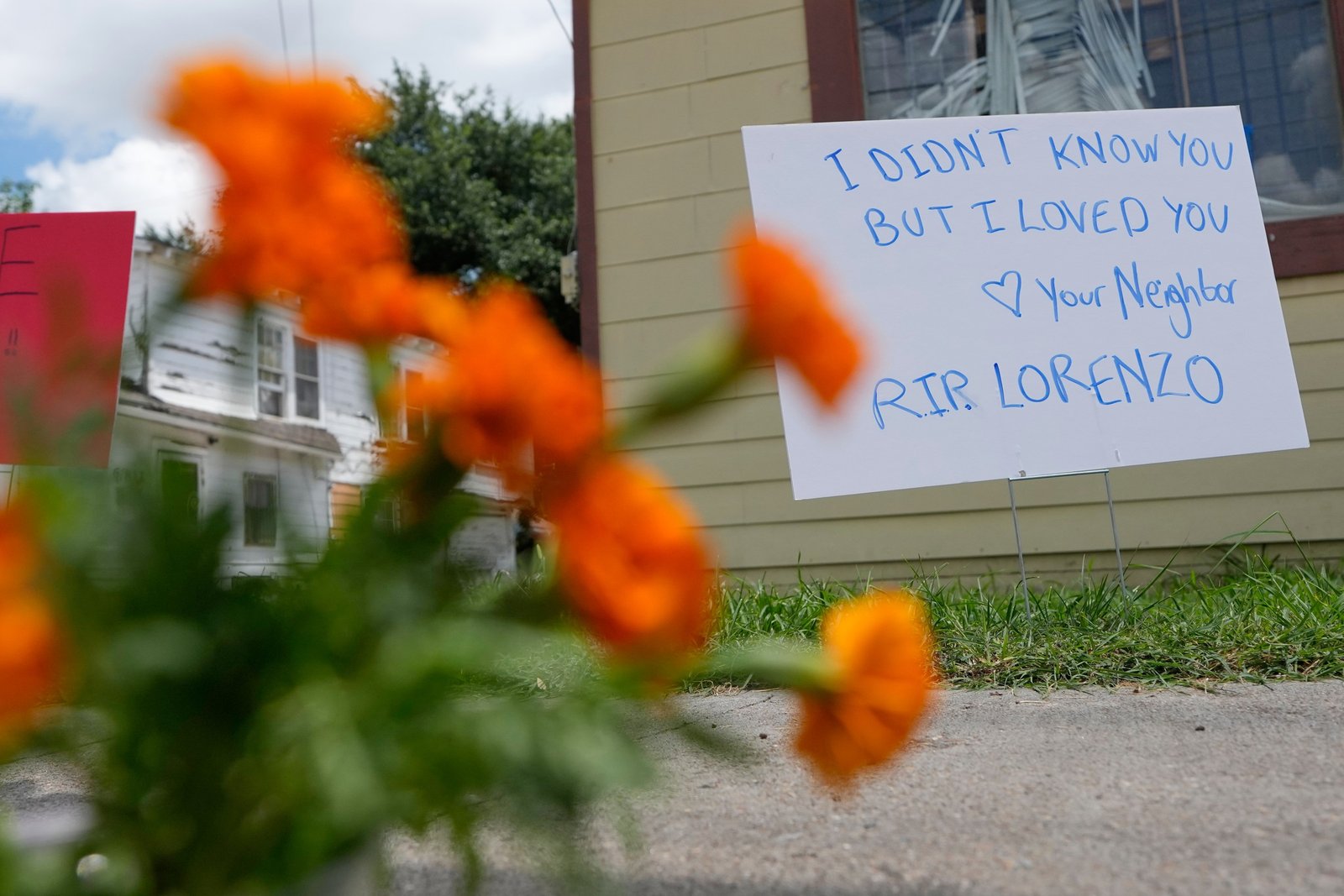
Lorenzo Salgado Araujo was a 52-year-old Mexican construction worker and small homebuilding-business owner who had lived in Houston for 35 years — a husband and father of three American sons, with no criminal record — and on the morning of July 7, 2026, an Immigration and Customs Enforcement officer named Gregory Feathers shot and killed him in his work van while he was driving his crew to a job site, in an operation in which, by the Department of Homeland Security's own later account, he was not the target. His name is in the headlines again this weekend because Senator-elect James Talarico, in his first public appearance since defeating Ken Paxton for Texas's Senate seat, went to the makeshift memorial on Canal Street on Saturday and placed his "I Voted" sticker where Salgado Araujo died.
The record of that morning is not in dispute in its outline, and it is worth stating plainly. The Texas Tribune reported that ICE agents were conducting surveillance on an address where they were looking for two Guatemalan men and a white van; the agents could make out only the first two letters of that van's license plate, and those letters matched Salgado Araujo's van, spotted in the same area. They ran his plate, learned that he was a Mexican man living in the country illegally who had no criminal record, and pursued him anyway — in the Tribune's words, neither he nor his passengers was the original target. Two unmarked SUVs chased the van through Magnolia Park, and at about 6:50 a.m. Feathers shot him in the abdomen, witnesses say through the open passenger-side window as he tried to park. None of the four agents involved wore a body camera, and there were no dash cameras. He died at Ben Taub Hospital, the Harris County medical examiner categorised his death as a homicide, and his three coworkers — including his brother Victor, in the front seat — were detained. This was a man who, the Associated Press reported, had done his biometrics and fingerprints earlier this year and was, in his son's words, close to obtaining his legal status.
What the government claims is simpler. The Department of Homeland Security said Salgado Araujo ignored commands, struck an ICE vehicle and "weaponized his vehicle in an attempt to run over an ICE law enforcement officer," and that the officer fired in self-defense; the department has defended the shooting the same way ever since. The three men inside the van tell it differently: through their lawyers they said no agent was ever positioned in front of or behind the van and that he never tried to strike an officer, and Victor Salgado told the Tribune the bullet passed right in front of his face before his brother screamed, "they have already killed me." Talarico, for his part, calls it plainly in his post from the memorial: "Lorenzo Salgado was murdered by ICE 4 months ago today."
"Lorenzo, our fellow Texan, deserves justice — and that's exactly what I'll fight for in the U.S. Senate." — Senator-elect James Talarico, at the memorial on Saturday
The common-sense principle underneath all of it is not complicated. A stop of the wrong man is supposed to end with the officers driving away and the man going to work. When the government kills a man it was not looking for — a man with no record, in the middle of getting his papers in order — the least it owes his family and the public is the whole truth, promptly: his name, the shooter's name, and the evidence. A self-defense claim that the government will not let anyone test is not an account; it is an assertion, and a family should not have to wait in the dark for basic answers.
The consequence of doing it the other way is written across this case. The federal government withheld the shooter's identity for nearly three months, and his name became public only because the U.S. Attorney's Office mistakenly released an internal ICE report, a Form I-213, that named him — a document the government then sealed. Harris County District Attorney Sean Teare, whose office is running the local investigation, has said the federal government has not directly provided his office with any information about the shooting at all. So a spot on Canal Street where a worker died in a stop meant for somebody else became, instead, the place where his son Ronaldo left his "I Voted" sticker on October 19, where more than a thousand stickers stood by Election Day, and where a senator-elect chose to make the first appearance of his term. House Democrats, for their part, are now planning to widen their probes of fatal ICE shootings, with subpoenas, when they take control in January. If a stop meant for somebody else can end in a funeral while the file stays sealed, who answers for the next one?
The details fill in the man behind the question people are typing. He was born in Tlatlaya, in the State of Mexico, came to Houston at 17, met his wife when they were teenagers, and raised three sons — all United States citizens — putting each of them through college on construction work: Ronaldo is a teacher, and Lorenzo Jr. is an engineer with a degree from Tufts University. He ran his own small homebuilding business, left home before dawn on July 7 with his dog at the porch, and picked up the crew he had worked beside for years — the tools in that van were, his son said, the tools he had used for 35 years to build homes so he could send his sons to college.
One detail shows how fast a dead man can be smeared, and how it ended. After the shooting, an FBI search warrant said a crystal-like substance had been seen inside the van. The family said it was salt — the crystallised salt the crew mixed into homemade electrolyte drinks to work through Houston's heat. On August 13, the U.S. Attorney for the Southern District of Texas, Aaron Reitz, confirmed the test result: the substance was not methamphetamine. The same case is one of the fatal ICE shootings behind the argument in our Questions section over accountability for federal agents.
The shooter, as the Tribune established, is Gregory Feathers, an ICE officer who had retired and was rehired within the past two years, in the middle of the second Trump administration's drive to bring former officers back for its deportation campaign. He has not been charged with a crime. Through his lawyer, Nicole DeBorde Hochglaube, he declined to comment, the lawyer saying Homeland Security policy prevents him from speaking during a pending investigation. What happens next sits in Harris County: Teare's office is convening a grand jury, the district attorney has said he expects to conclude it soon, the county gave his office $2.5 million in August for an independent investigation assisted by the Texas Department of Public Safety, and the FBI, the U.S. Attorney's Office and Homeland Security are running their own separate probes. His sons have testified twice — at a congressional oversight forum in Houston on July 24 and a Senate forum on September 22 — and Representative Sylvia Garcia is preparing a heat-safety bill for construction workers that carries his name, the Lorenzo Salgado Araujo Construction Safety Act. At the July hearing, Lorenzo Jr. said of his father, "He didn't need anybody to know his name."
His oldest son said who he was best, the day after he was killed. "He did not deserve to die. He did not deserve to be reduced to a headline of Mexican man shot and killed by ICE. He deserved to live a quiet life as Lorenzo Salgado Araujo, a husband, a father and a job creator for dozens of men who also wanted the American dream."