Will Trump Be Able to Build His Triumphal Arch?
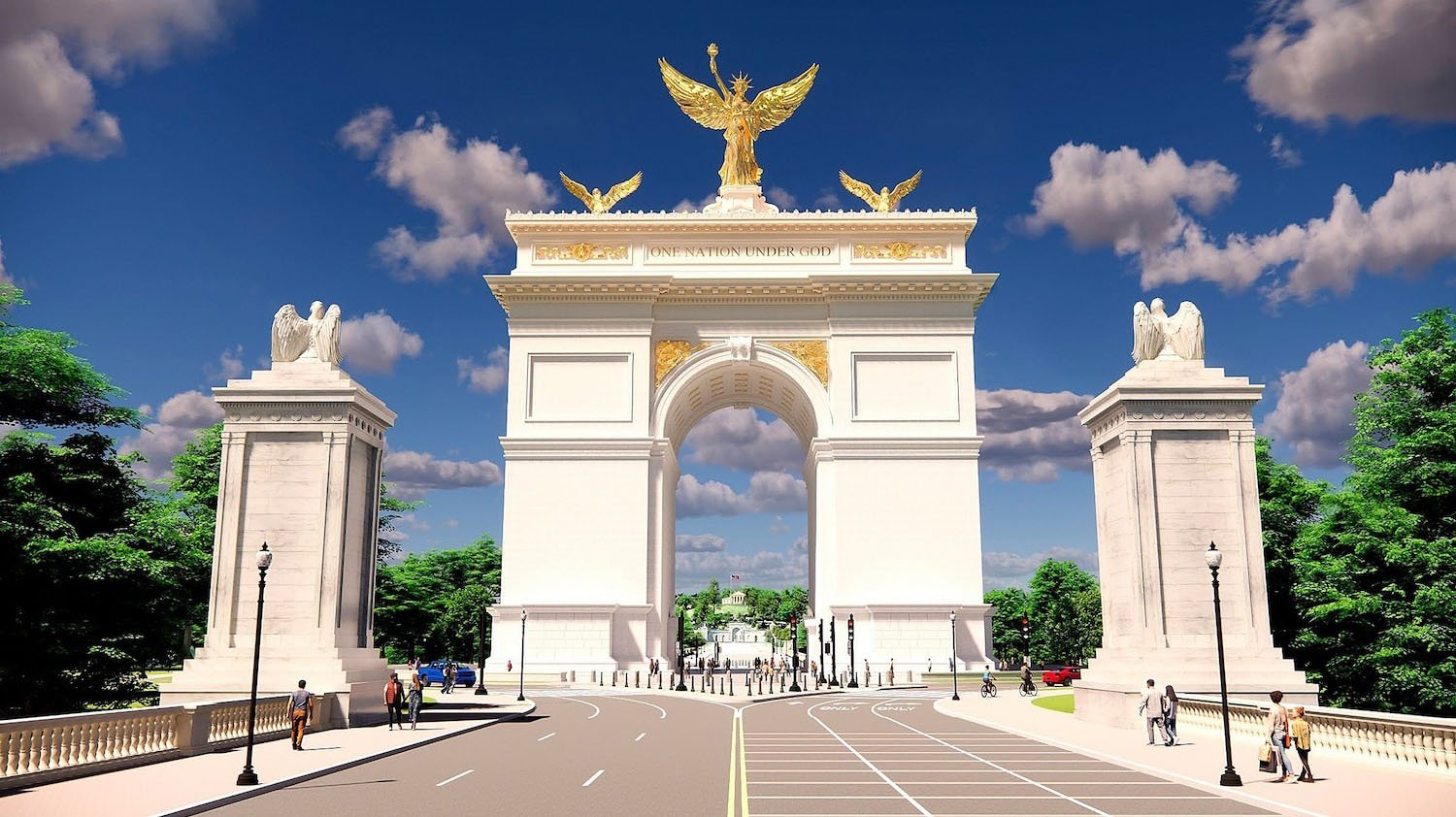
Not now — and not unless the courts change their mind and Congress gives the approval the lawsuits say he never got. Construction of President Trump's proposed 250-foot Triumphal Arch is halted today by a federal judge's order, no court has ruled that he may proceed, and on Tuesday nine members of the Kennedy family joined the fight to stop it for good. As things stand, the only thing being built is the case against it.
The plain reality is a gap between an approval and a permission. A federal panel, the National Capital Planning Commission, voted on November 5 to approve the project — and within hours, U.S. District Judge Tanya S. Chutkan temporarily blocked the administration from beginning construction, granting the temporary restraining order that the governments of Washington, D.C., and Virginia had asked for. The order stops work for at least 14 days, and the judge has said she is considering a longer block. The Kennedys' complaint, filed Tuesday in federal court in Washington, argues the deeper point: the National Park Service and the Interior Department authorized construction without the congressional approval that commemorative works in the capital require.
The White House claims the block is politics, not law. Spokesman Davis Ingle called the judge's order the work of "an activist district court," said it was unfortunate that members of the Kennedy family had joined the litigation against a project "intended to honor our heroes who rest in Arlington Cemetery," and insisted the judiciary "should not be abused to politicize a structure designed to unite our nation." Trump himself said in September that the arch was being built for national security purposes at the Pentagon's request, as a top-grade military complex — a claim the Pentagon declined to comment on at the time, and one Judge Chutkan noted had appeared nowhere in the planning documents the project was actually reviewed and approved on.
The common-sense principle is older than the argument. A monument on sacred public ground is built by permission, not by declaration: first the people's representatives approve it, then the builders build it. An approval from a panel of the president's own allies, followed within hours by a judge's stop order, is not that permission.
The Arch will permanently cast a shadow over the Kennedy Gravesites and the graves of servicemen and women who made the ultimate sacrifice for this country. — The Kennedy family's lawsuit
The consequence of building first and asking later is that a monument meant to mark 250 years of American independence now has to survive its own birth in court. The arch would stand 250 feet tall — as tall as a 25-story office building — in Memorial Circle at the western end of the Arlington Memorial Bridge, across the Potomac from the Lincoln Memorial, on the approach to a cemetery where more than 400,000 service members and their families are buried. Every new plaintiff adds weight against it: the District of Columbia and Virginia, three Vietnam War veterans and an architectural historian, Arlington County — which is also suing over Trump's statement that the arch would double as a military facility for storing and deploying drones and positioning snipers — and now the family of the president whose grave sits in its shadow. If a monument needs this much litigation simply to exist, whose monument is it really?
The details that decide the answer are these. The Kennedy suit — brought by Rory Kennedy, Maxwell Taylor Kennedy, Christopher G. Kennedy, Kerry Kennedy, Kathleen Kennedy Townsend, Joseph P. Kennedy II, Joseph P. Kennedy III, Edward M. Kennedy Jr. and Courtney Kennedy, and argued by the Democracy Defenders group — says the arch would obstruct a sightline between the Lincoln Memorial and Arlington that was designed after the Civil War to represent the reunification of the nation and has stood for nearly a century. John F. Kennedy's gravesite was deliberately built low to the ground to protect that view; a retaining wall behind it was removed in 1965 for the same reason. A forensic study cited in the filing found the arch's shadow would fall hardest in the early morning, when family members visit. Judge Chutkan, in her ruling, wrote of the administration's last-minute national security claims that they "materialized, for the first time, when Defendants filed their opposition brief last week." Our earlier report covered the judge's block, issued hours after the federal panel approved the arch; what has changed since is the number and the names of the people asking the court to make that block permanent. The temporary order runs at least 14 days from November 5, which puts the next decision point around November 19 — and until a court lifts it or Congress acts, not one stone of the arch can lawfully rise.
The family closed its statement with the line that explains why nine private citizens are standing in a federal courtroom over a monument: "In bringing this lawsuit, we stand for those who cannot stand for themselves."